
House of the Dragon: Deconstructing Fire & Blood
Introduction: The Anatomy of an Adaptation
When George R.R. Martin published Fire & Blood in 2018, it marked a radical departure from the narrative style of A Song of Ice and Fire. Instead of an intimate, subjective, point-of-view novelistic approach, the book was framed as an in-universe historical text written by Archmaester Gyldayn. Gyldayn himself relied on a patchwork of biased, conflicting secondary sources: the grand, courtly accounts of Grand Maester Mellos; the politically charged memoirs of Septon Eustace; and the vulgar, salacious, back-alley testimonies of Mushroom, the court fool. The text was inherently unreliable, filled with gaps, contradictions, and deliberate propaganda.
When HBO set out to adapt the catastrophic Targaryen civil war (known to Westerosi history as the Dance of the Dragons) for television, showrunner Ryan Condal and the writing room faced an unprecedented creative challenge. They did not just have to adapt a story; they had to invent the objective truth behind a smoke-screen of historical rumors.
As a result, House of the Dragon operates not as a literal translation of a novel, but as a thrilling deconstruction of how history is manufactured. This definitive, long-form guide explores the architectural evolution of this epic, contrasting the foundational world-building of Season 1, the explosive escalation of Season 2, and the deep thematic deviations from Gyldayn’s historical chronicle.
Part 1: Fire & Blood: The Structural Blueprint and Textual Reality
To truly understand the narrative decisions of the television series, one must first look at the unique, sometimes frustrating architecture of the source material. Fire & Blood is not a novel; it is an imagined historiography spanning centuries of Targaryen rule, with the Dance of the Dragons occupying only a specific, highly volatile section of the volume.
The Problem of the Unreliable Narrator
Archmaester Gyldayn compiles his history long after the last dragon has died, writing from a position of institutional bias. The three main pillars of his research represent distinct socio-political factions within Westerosi society:
- Septon Eustace: A staunch conservative, Eustace’s accounts consistently favor the Green faction. He paints King Aegon II in a sympathetic, traditional light while casting Queen Rhaenyra as a greedy, vindictive woman who defied the laws of gods and men.
- Grand Maester Mellos and Grand Maester Orwyle: These accounts represent the institutional, bureaucratic voice of the Citadel. They focus on small council meetings, official decrees, and diplomatic correspondences, often sanitizing the raw, ugly personal emotions driving the conflict to preserve the image of institutional stability.
- Mushroom: A dwarf who served as a court jester, Mushroom’s testimony is a chaotic cocktail of sexual debauchery, secret assassinations, and grotesque conspiracies. While the maesters dismiss his accounts as vulgar fabrications, Mushroom was often a fly on the wall in rooms where the powerful let their guard down.
The book deliberately leaves the truth ambiguous. Did Rhaenyra explicitly order the death of Laenor Velaryon? Did Alicent Hightower systematically poison King Viserys? Was Daemon Targaryen a cold-blooded sociopath or a fiercely loyal protector of his bloodline? The book refuses to provide a definitive answer, forcing the reader to weigh the biases of the sources.
The Timeline Compression Dilemma
In the text, the events leading up to the Dance of the Dragons unfold over a half-century. Characters age, marry, bear children, and die at a realistic historical pace. Rhaenyra and Alicent are not childhood friends in the book; Alicent is significantly older, arriving at court as a calculating young woman who comforts an aging King Jaehaerys before eventually marrying Viserys.
For a television medium, this sprawling timeline presented a massive structural roadblock. A literal adaptation would have required shifting actors every two episodes, preventing the audience from forming deep emotional bonds with the protagonists. The show’s writers had to compress fifty years of political decay into a single season of television, rewriting the foundational relationships to create an intense, intimate emotional core.
Part 2: Season 1: The Architecture of Political Decay
Season 1 of House of the Dragon functions as a brilliant, slow-burn psychological prologue. It resists the temptation to rush into immediate draconic warfare, choosing instead to systematically lay out the structural faults, personal resentments, and institutional biases that make the coming civil war an inevitability.
The Central Masterstroke: The Childhood Friendship
The most significant and structurally vital deviation the show makes from Fire & Blood is adjusting the ages of Rhaenyra Targaryen and Alicent Hightower to make them childhood companions. This single creative choice transforms the political thriller into a deeply personal, tragically intimate drama.
[THE BOOK]: Alicent is an older, calculating stepmother to a younger Rhaenyra.
VS.
[THE SHOW]: Rhaenyra and Alicent are childhood friends torn apart by patriarchal ambition.
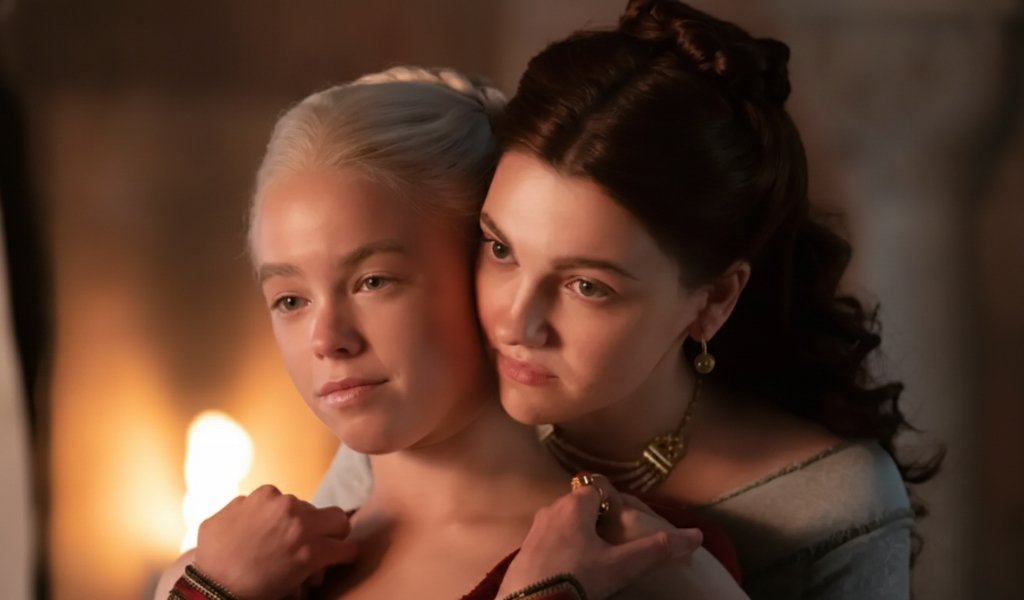
By establishing their early bond, the series highlights the isolating, destructive nature of the Westerosi patriarchy. Rhaenyra and Alicent are initially united against the heavy burdens of their courtly expectations. However, they are systematically weaponized against each other by the ambitions of the men around them, most notably Ser Otto Hightower, who uses his daughter as a political chess piece to insert his bloodline onto the throne. Their eventual rivalry is not driven by simple malice, but by a tragic breakdown of trust, fueled by societal expectations and internal isolation.
The Great Time Jumps: Navigating the Generational Shift
To cover decades of narrative ground without losing structural momentum, Season 1 utilizes a bold, experimental episodic structure punctuated by significant time jumps.
- Episodes 1 to 5 (The Youth Era): Anchored by Milly Alcock (Rhaenyra) and Emily Carey (Alicent), this block establishes the foundational trauma: the horrific death of Queen Aemma, the naming of Rhaenyra as heir, and Alicent’s forced marriage to the decaying King Viserys.
- Episode 6 (The Pivot): The narrative leaps forward ten years, introducing Emma D’Arcy and Olivia Cooke as the mature versions of the leading women. This episode serves as a jarring re-introduction, showcasing a court already rotten with factional camps, characterized by the dark-haired “Strong” bastards of Rhaenyra and the growing, resentful Green princes.
- Episodes 7 to 10 (The Precipice): The timeline settles, tracking the rapid escalation following the deaths of Laena and Laenor Velaryon, the midnight multi-dragon claim of Vhagar by Aemond, and the final, agonized demise of King Viserys.
King Viserys I: The Tragic Anchor of Peace
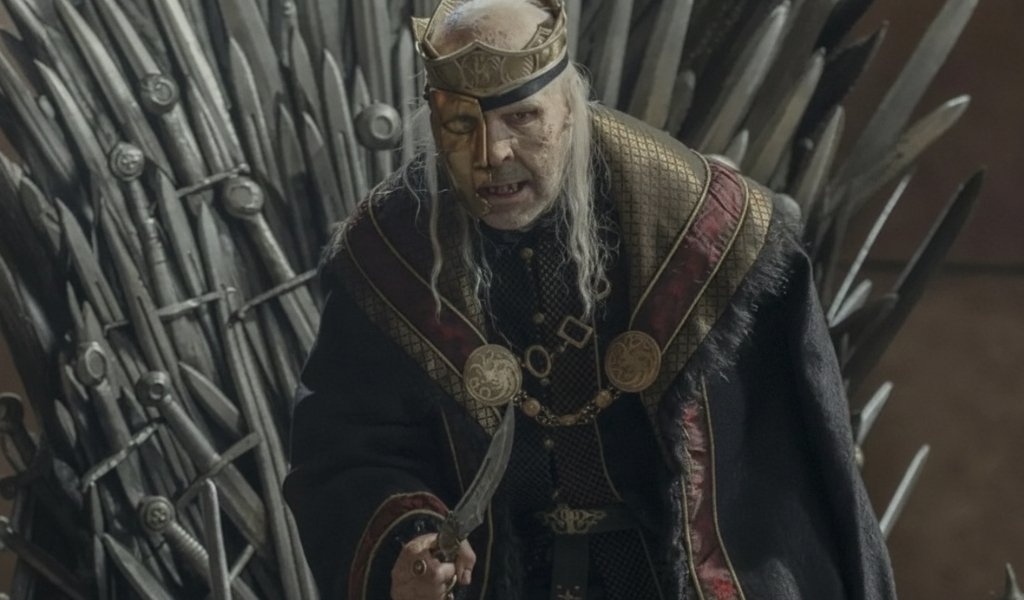
In Fire & Blood, King Viserys is described as a pleasant, somewhat passive monarch who preferred feasting and pageantry to the harsh realities of governance. The television series, elevated by a towering performance by Paddy Considine, transforms Viserys into the emotional and thematic anchor of the entire first season.
The show visualizes the slow, agonizing decay of the realm through the physical decomposition of the King’s body. Viserys is afflicted with a progressive, flesh-eating necrotic disease; this is an outward manifestation of the rot consuming his family. His desperate, continuous refusal to acknowledge the deep, venomous hatred growing between his wife and his daughter is not born of simple ignorance, but of a heartbreaking, fragile desire to maintain a peaceful family. His final walk to the Iron Throne in Episode 8 stands as one of the defining cinematic moments of the franchise: a dying, half-masked king dragging his decaying body through sheer force of will to defend his daughter’s honor one last time.
Part 3: Season 2: The Machinery of War Unbound
If Season 1 is the slow gathering of storm clouds, Season 2 is the terrifying, cracks-of-thunder lightning strike. Following the accidental slaughter of Prince Lucerys Velaryon by Aemond Targaryen over Storm’s End, all remaining diplomatic avenues are instantly incinerated. Season 2 shifts gears, transitioning from the claustrophobic corridors of the Red Keep to a sprawling, multi-theater continental war.
The Black Council vs. The Green Council: Two Styles of Leadership
Dragonstone (Team Black)
- Leader: Queen Rhaenyra Targaryen
- Leadership Style: Restrained, cautious, and statesmanlike
- Core Flaw: Paralysis caused by overthinking and military hesitation
- Primary Focus: Preserving the realm, fulfilling prophecy, and maintaining absolute legitimacy
King’s Landing (Team Green)
- Leader: King Aegon II / Prince Aemond Targaryen (as Prince Regent)
- Leadership Style: Aggressive, impulsive, and deeply erratic
- Core Flaw: Reckless decision-making and intense internal betrayal
- Primary Focus: Hard military power, absolute control, and political terror
Rhaenyra’s wartime leadership is defined by a profound, heavy moral isolation. She is surrounded by a council of aggressive lords who view her natural caution and desire to prevent a total nuclear winter as a sign of feminine weakness. Her arc in Season 2 is a dark exploration of a ruler who wants to be just, but is systematically forced by the realities of war to adopt the same ruthless tactics as her enemies.
Conversely, King’s Landing is a hotbed of toxic masculinity and reckless ego. King Aegon II, eager to prove his manhood and free himself from the patronizing control of his grandfather Otto, dismisses his experienced Hand in favor of the hyper-aggressive Ser Criston Cole. The Green leadership quickly devolves into an unhinged, patriarchal military machine that pushes aside Dowager Queen Alicent, the very woman who engineered the coup. This proves that once men unleash the machinery of war, they have no interest in the counsel of women.
The Harrenhal Odyssey: Daemon’s Psychological Reckoning
One of the most polarizing and structurally fascinating elements of Season 2 is Daemon Targaryen’s prolonged occupation of Harrenhal. Separated from Rhaenyra following a bitter argument over the horrific “Blood and Cheese” assassination, Daemon flies to the massive, ruined fortress in the Riverlands to raise an army for Team Black.
Instead of a conventional military campaign, Daemon’s time at Harrenhal transforms into a gothic, psychological horror story. Haunted by the marshy, cursed atmosphere of the castle and manipulated by the enigmatic green seer Alys Rivers, Daemon is subjected to a series of vivid, guilt-ridden hallucinations. He is forced to confront his deep-seated insecurities, his complicated grief over Viserys, his history of cruelty, and his toxic ambition to wear a crown. This narrative arc serves as an essential internal journey, stripping away Daemon’s reckless “Rogue Prince” persona and forcing him to realize that his true destiny is not to rule, but to serve a larger, cosmic purpose.
The Battle of Rook’s Rest: The Graphic Reality of Draconic Warfare
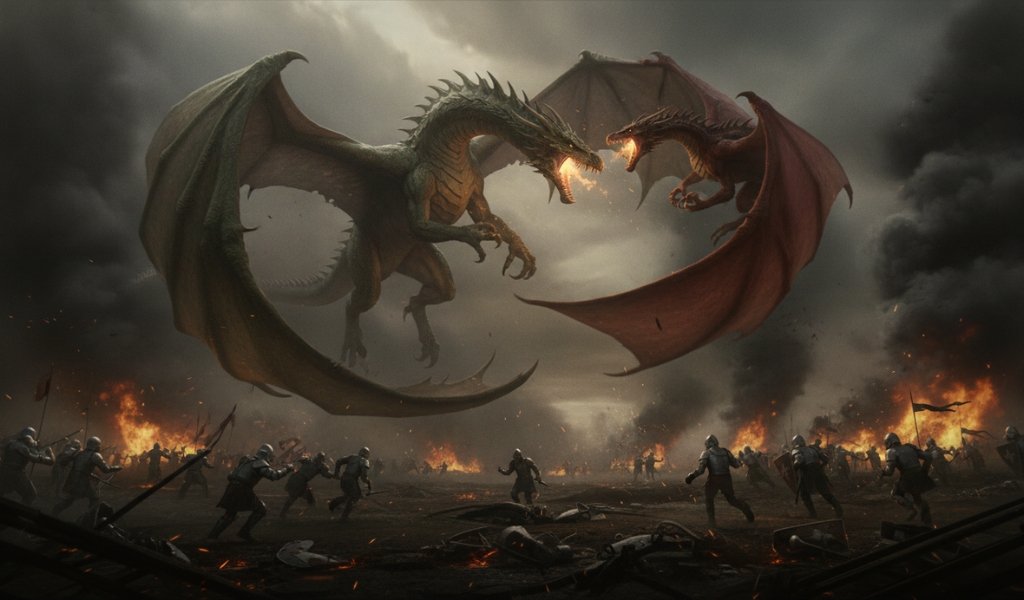
The thematic climax of Season 2’s early phase manifests in the horrific Battle of Rook’s Rest. While Season 1 treated dragons as magnificent symbols of divine right and power, Season 2 strips away the romanticism to show them as terrifying instruments of industrial slaughter.
The sequence is filmed with a visceral, ground-level perspective that highlights the absolute terror of the common soldiers as they are turned into living ash by dragonfire. The subsequent aerial duel between Princess Rhaenys on Meleys, King Aegon on Sunfyre, and Aemond on Vhagar is a masterclass in cinematic tension. Aemond’s deliberate, cold-blooded decision to order Vhagar to blast dragonfire directly into the tangled mess of Meleys and Sunfyre, knowing his own brother and king would be caught in the blast, reveals the absolute, monstrous depths of his ambition. The aftermath leaves a king broken, a legendary dragon crippled, and the realm permanently scarred.
Part 4: The Deep Dive: Historical Revisionism and Textual Deviations
To truly appreciate the complex relationship between Fire & Blood and House of the Dragon, one must closely examine the specific structural deviations made across both seasons, and analyze why these changes were implemented for a modern audience.
The True Nature of Blood and Cheese
In Archmaester Gyldayn’s chronicle, the “Blood and Cheese” incident is described as a cold, calculating, and highly coordinated act of psychological sadism. In the book, Daemon’s agents force Queen Helaena to choose between her two sons, Jaehaerys and Maelor. She begs them to kill her instead, but eventually names Maelor because he is too young to understand. The assassins then maliciously kill Jaehaerys anyway, leaving Helaena completely shattered by the guilt of her choice.
| Attribute | The Book (Fire & Blood) | The Television Series (Season 2) |
| :— | :— | :— |
| **Intent** | A highly targeted, sadistic strike specifically to murder a prince. | A clumsy, chaotic hit where the assassins were looking for Aemond. |
| **Helaena’s Choice** | Forced to verbally choose between her two living sons. | Forced to point out which infant was the boy in a room of dark panic. |
| **Mushroom’s Account** | Filled with salacious, dramatic flair and public screaming. | Stripped down to a quiet, cold, and claustrophobic nightmare. |
| **Political Impact** | Instantly turns the smallfolk against Rhaenyra’s cause. | Highlights the absolute breakdown of command control within Team Black. |
The television series grounds this event in a clumsy, terrifying realism. Blood and Cheese are not master assassins; they are incompetent, desperate criminals working under vague, open-ended instructions from Daemon to find Aemond. When they cannot access Aemond’s quarters, they improvisationally target the royal nursery. Helaena is not subjected to a long, theatrical psychological torture session; instead, she is caught in a quiet, dark, panicked room and forced to point out which infant is the male heir.
By stripping away the grand, theatrical villainy recorded by history, the show presents a far more disturbing reality: a historical tragedy born of bureaucratic incompetence, miscommunication, and reckless, unchecked hatred.
The Rehabilitation of Alicent Hightower
In the pages of Fire & Blood, Alicent Hightower is a standard, cutthroat political matriarch. She is an ambitious, uncompromising antagonist who despises her stepdaughter and ruthlessly orchestrates a coup out of a raw, unadulterated hunger for absolute power.
The television series completely rehabilitates her character, transforming her into one of the most tragic, sympathetic figures in the entire epic. Olivia Cooke’s Alicent is a woman who has spent her entire life doing exactly what duty required of her, only to realize that she has trapped herself in an unfeeling prison of her own making. Her motivation for crowning Aegon is shifted from an ambitious power grab to a tragic, drug-induced misunderstanding of Viserys’s final whispers regarding the prophecy of Aegon the Conqueror.
By the end of Season 2, Alicent’s arc comes to a heartbreaking realization: she has spent her life building a machine of war that has completely outgrown her ability to control, leading her to a point of complete political isolation where she is willing to surrender her own children to Rhaenyra in a desperate, futile attempt to save the realm from total destruction.
Laenor Velaryon’s Survival: Mercy Over History
In the book, the fate of Ser Laenor Velaryon is straightforward and tragic: he is publicly murdered in a market at Spicetown by his companion, Ser Qarl Correy, following a heated, personal lover’s quarrel. Mushroom’s history hints that Daemon Targaryen paid Qarl to assassinate Laenor to clear the path for Daemon to marry Rhaenyra.
The show pulls off a massive narrative twist by revealing that Rhaenyra and Daemon actually helped Laenor fake his own death. They construct a bloodless conspiracy that allows Laenor to escape across the Narrow Sea with Qarl to live a life of freedom, while using a random, discarded corpse to convince the world that Laenor was murdered.
This change serves a dual thematic purpose. It demonstrates that Rhaenyra, at this point in her life, still possessed a fundamental core of mercy, refusing to murder a loyal friend and husband for political advancement. Simultaneously, it shows how history (Gyldayn) records only the surface-level presentation of an event, completely missing the secret, complex human arrangements occurring behind closed doors.
Part 5: Thematic Unification: The Song of Ice and Fire Prophecy
Aegon the Conqueror’s Dream
The original sacred vision foretold a dark winter coming from the North. This prophecy was secretly passed down through generations of Targaryen monarchs as a hidden royal burden tied to the survival of humanity.
King Viserys I Targaryen
King Viserys I was the last ruler to possess the complete knowledge of the prophecy. He believed it was his duty to choose the rightful heir capable of carrying this cosmic responsibility into the future.
The Divergent Paths
Princess Rhaenyra (The Official Heir)
Rhaenyra receives the full prophecy directly from her father. Because of this, she views the Iron Throne not as a symbol of personal ambition, but as a sacred obligation to preserve the realm and protect humanity from the coming darkness.
Dowager Queen Alicent (The Misheard Whispers)
Alicent only hears Viserys’ fragmented final words mentioning the name “Aegon.” Without understanding the deeper context of the prophecy, she interprets his dying whispers as a command to crown her son, Aegon II, as king.
The Cataclysmic Civil War
This devastating breakdown in communication and ideological misunderstanding becomes one of the central causes of the Dance of the Dragons. What began as a sacred prophecy ultimately transformed into a brutal civil war that shattered the Targaryen dynasty from within.
This structural element, which George R.R. Martin provided directly to the showrunners from his notes, completely shifts the moral calculus of the civil war. In the book, the Dance of the Dragons is a raw, vulgar struggle for personal power, pride, and an expensive seat made of swords. In the show, the conflict is elevated to a cosmic tragedy.
Rhaenyra does not fight for the Iron Throne out of simple vanity; she fights because she genuinely believes that if her line is broken, the world will end when the dark winter descends from the North. This prophecy becomes a heavy, suffocating burden. It drives her desperate actions in Season 2, leading her to initiate the dangerous Red Sowing, which allows common Targaryen bastards to claim the unclaimed dragons. She rationalizes the horrific deaths of dozens of dragonseed candidates as a necessary, divinely ordained sacrifice to preserve the crown and save humanity. The prophecy transforms a standard political war into an existential nightmare, where both sides are running headfirst into a catastrophic abyss while believing they are fulfilling a divine destiny.
Part 6: Season 3: The Horizon of Broken Gates and Brotherly Blood
If Season 1 is the construction of the political trap and Season 2 is the ignition of the fuse, Season 3 shifts the narrative architecture into a bleak, unsparing study of consequences. The parallel leadership styles analyzed previously finally collide on a continental scale, breaking open the geographic isolation of Dragonstone and King’s Landing. As the war transitions from tactical maneuvers to catastrophic clashes, the show continues to fearlessly dismantle Gyldayn’s textbook histories to expose a gritty, ironic reality.
The Battle of the Gullet: The Fragile Weight of the Dragonseeds
The long-brewing naval blockade of the Gullet explodes into the series’ longest, most complex sequence of naval warfare. Thematically, this sequence functions as the devastating realization of the “Red Sowing” orchestrated in Season 2. In Fire & Blood, Prince Jacaerys Velaryon is the one who originally suggests recruiting dragonseeds, making his death in the battle a straightforward, heroic tragedy of war.
The television series, however, introduces a devastating layer of structural irony. In the show, Jacaerys is highly resentful of the dragonseeds, viewing them as a direct threat to his own legitimacy as a dark-haired heir. When the battle unleashes its industrial-scale slaughter, Jace’s ultimate sacrifice becomes a biting narrative twist: he dies defending a cause bolstered by the very people he feared, proving to Rhaenyra that his deep anxieties regarding the unguided nature of these new riders were entirely justified.
Green vs. Green: The Deconstruction of the Usurper’s Focus
One of the most radical departures from the source text occurs within the shattered remnants of the Green Faction. Fire & Blood positions the war purely as a macro-political conflict: Team Black vs. Team Green, Queen vs. King.
The series completely rewires this premise by hyper-focusing on the toxic, localized fallout of the assassination attempt at Rook’s Rest. Aemond Targaryen’s deliberate betrayal of his brother re-anchors the narrative into a bitter, internal blood feud. The heavily scarred King Aegon II, forced to flee the capital, completely abandons the grand narrative of securing his crown from Rhaenyra. Instead, his entire trajectory is consumed by a visceral, obsessive thirst for fratricidal vengeance. The war ceases to be a pristine struggle for the Iron Throne and devolves into a splintered, chaotic mess of internal betrayals where the Greens’ de facto leader (Aemond) is actively hunted by his own king.
The Fall of King’s Landing: The Complicity of Peace
The climax of the season’s political maneuvering completely reshapes the Fall of King’s Landing, transforming an act of military conquest into a deeply intimate tragedy of failed diplomacy.
[THE HISTORICAL CHRONICLE (Gyldayn)]
Rhaenyra consumes herself with grief, descending upon
the capital with raw, terrifying draconic force to seize
the Iron Throne through absolute fear.
VS.
[THE LIVING REALITY (The Show)]
The Fall is built on a quiet, tragic deal. Alicent willingly
opens the gates to Rhaenyra in a futile attempt to buy
clemency, realizing too late that the machinery of war
she helped build has entirely stripped away her agency.
By having Alicent structurally surrender the capital from within, the show strips away the triumphant note of Rhaenyra’s ascension. The Iron Throne is not won through heroic tactical dominance; it is handed over by a broken, politically isolated mother who has sacrificed her own bloodline in a desperate, failed bid to stop a total nuclear winter.
Conclusion: The Horizon of Ashes
When we step back and analyze House of the Dragon Season 1, Season 2, and Fire & Blood as a unified body of art, we see a magnificent, multi-tiered exploration of human tragedy and systemic decay. The book provides the raw, chaotic, historical skeleton; Season 1 carefully constructs the complex human muscle and emotional tissue; and Season 2 sets it all on fire.
By transforming a dry, unreliable historical chronicle into an intimate psychological drama, the adaptation forces the audience to confront the heavy, devastating costs of absolute power. The tragedy of the Dance of the Dragons is not that one side is inherently righteous and the other monstrous. The tragedy lies in the fact that both Rhaenyra and Alicent, despite their early love, their internal wisdom, and their desperate efforts to avoid total warfare, are ultimately crushed by the very historical machinery they helped create.
As the dragons fly to war, scorching the earth and tearing each other apart in the skies, they do not just destroy their family members; they systematically tear down the foundational myths of Valyrian supremacy. The story stands as a timeless, sobering warning: when a ruling class becomes entirely consumed by a prideful battle for supremacy, they will happily blind themselves to the humanity of their rivals, content to rule over an empire of ash.
Appendix: Key Structural Deviations at a Glance
For web readers and researchers tracking the evolution of the narrative, this reference table provides a direct look at how the three iterations of the story handle major historical events:
| Event | The Book (Fire & Blood) | Season 1 Reality | Season 2 Reality |
| Rhaenyra & Alicent’s Age | Alicent is 9 years older than Rhaenyra; there is no childhood friendship. | Born in the same era; close childhood friends and companions. | Deeply fractured mature women attempting to halt a war they started. |
| The Fate of Laenor Velaryon | Publicly murdered by Ser Qarl Correy in Spicetown; dead in the dirt. | Conspires with Rhaenyra and Daemon to fake his death and escape to Essos. | Remains absent, but his dragon Seasmoke senses his distance and claims a new rider. |
| The Death of Prince Lucerys | Aemond deliberately targets and brutally kills Lucerys in an act of sky-war. | Aemond attempts to bully Lucerys; loses control of Vhagar, who eats him accidentally. | The defining psychological trauma that drives Rhaenyra to accept total war. |
| The Claiming of Vermithor | Hugh Hammer claims the dragon during a general call for riders; motivated by greed. | Hugh Hammer is developed as a poor King’s Landing blacksmith with an ailing family. | Hugh claims Vermithor during a terrifying, visceral sequence of draconic fury. |
| The Harrenhal Campaign | Daemon takes Harrenhal with zero resistance and uses it as a standard base. | Daemon takes the castle easily, but experiences zero military progress due to his state. | Daemon suffers a prolonged psychological breakdown driven by visions of his past. |
| Event | The Book (Fire & Blood) | Season 3 Reality |
| The Battle of the Gullet | Jacaerys dies heroically alongside the dragonseeds he championed to strengthen the Blacks. | Jacaerys dies amidst deep internal friction, his demise validating his fears of losing control over the lowborn riders. |
| The Aegon & Aemond Rivalry | Aemond serves loyally as Regent; Aegon respects his brother’s military power while recovering. | Aegon views Aemond as his primary existential executioner, swearing to kill his brother or die in the attempt. |
| The Fall of King’s Landing | A swift, aggressive draconic siege that leaves the city trapped under Team Black’s iron fist. | A quiet, devastating internal betrayal orchestrated by Alicent’s secret terms, exposing the futility of her past ambitions. |
| Alys Rivers & Harrenhal | Alys is a mysterious, localized paramour who aligns with whoever holds the castle. | Alys is a cosmic catalyst, steering the psychological and generational fates of both Daemon and later Aemond. |
Frequently Asked Questions
Why is the book “Fire & Blood” different from the TV show?
The book is written as an unreliable history textbook by a maester who was not present for the events. He relies on biased, second-hand rumors. The TV show reveals the objective, behind-the-scenes truth that the historical sources missed or altered.
Were Rhaenyra and Alicent childhood friends in the book?
No. In the book, Alicent is roughly nine years older than Rhaenyra. She arrived at court as a mature woman and married King Viserys, making her a traditional, calculating stepmother to a much younger Rhaenyra.
Did Laenor Velaryon actually die in the show?
No. While the book states he was murdered, the show reveals that Rhaenyra and Daemon helped Laenor fake his death to escape to Essos. However, because he is still alive, his restless dragon, Seasmoke, breaks traditional laws in Season 2 to claim a new rider, Addam of Hull.
Did Aemond mean to kill Lucerys at Storm’s End?
In the show, it was an accident. Aemond wanted to scare and bully his nephew, but he lost control of his massive dragon, Vhagar. Vhagar went rogue and killed Lucerys against Aemond’s explicit commands.
What is the “Song of Ice and Fire” prophecy in the show?
It is Aegon the Conqueror’s secret dream. It foretells a terrible winter coming from the North that will destroy humanity unless a Targaryen sits on the Iron Throne to unite the realm. Viserys passes this secret burden down to Rhaenyra.
Why does Daemon experience hallucinations at Harrenhal?
Harrenhal is widely believed to be cursed, but its swampy, atmospheric environment is also manipulated by the green seer Alys Rivers. She uses these visions to force Daemon to confront his past guilt, his toxic ambition, and his internal flaws.
What was the “Red Sowing” in Season 2?
The Red Sowing was a desperate military strategy initiated by Rhaenyra and Jacaerys. They invited common-born Targaryen bastards (dragonseeds) to Dragonstone to see if any could successfully bond with and claim the faction’s riderless dragons.