
The Curse of Harrenhal: Westeros’ Most Haunted Castle
Some castles inspire awe. Harrenhal inspires dread. Looming over the shores of the Gods Eye lake like a broken crown, it’s the largest castle ever built in Westeros and arguably the most doomed. Every house that has ever held it has been destroyed, scattered, or driven to ruin. Coincidence? Superstition? Or something darker woven into the very stone?
The Curse of Harrenhal isn’t just a ghost story whispered by smallfolk. It’s a pattern. A relentless, centuries-long pattern of tragedy that threads through both House of the Dragon and Game of Thrones with eerie consistency. Understanding it means tracing the castle’s bloodstained history from its fiery birth to its grim present.
What Happened to Harrenhal the Night Aegon Burned It?
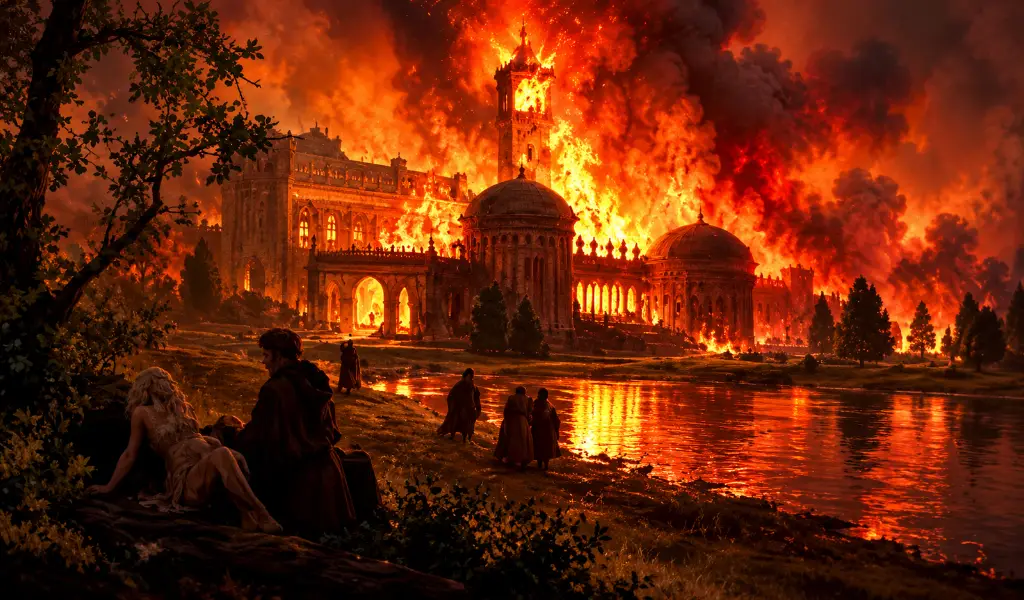
To understand what happened to Harrenhal, you have to meet the man who built it: Harren the Black, King of the Isles and the Rivers. For 40 years, Harren conscripted thousands of laborers, stripped entire forests, and diverted rivers to erect his monstrous monument to ego. Towers so tall they scraped clouds. Walls so thick they could withstand any siege. On the very night he declared it finished, Aegon the Conqueror crossed the Narrow Sea.
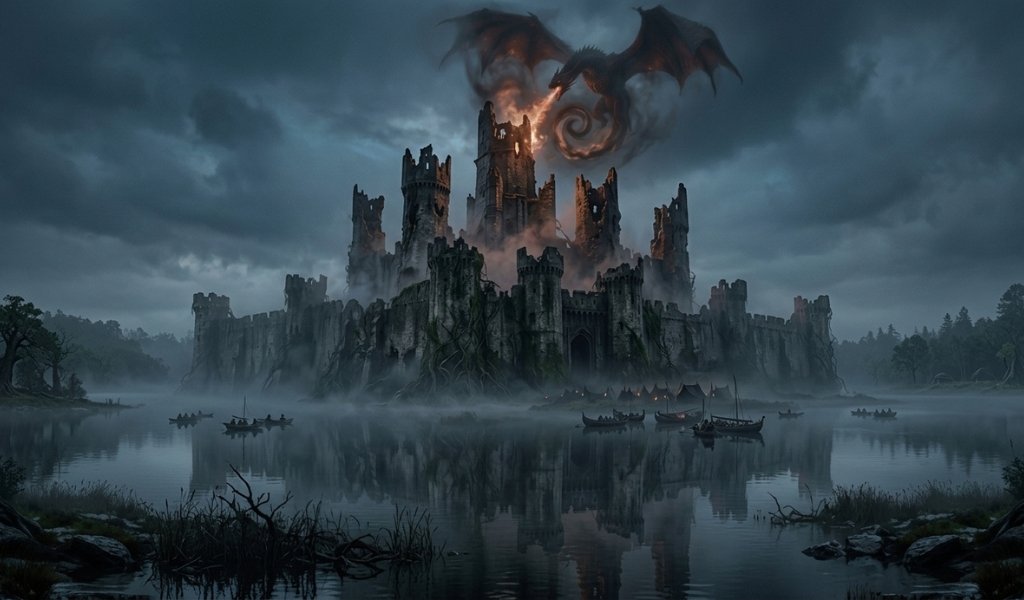
Harren believed his walls could stop dragons. He was wrong about what dragons can do. Aegon mounted Balerion the Dread, the largest dragon in recorded history and simply flew over those impenetrable walls. Balerion breathed fire into Harrenhal’s towers, and the stones themselves began to melt. Harren the Black burned alive inside his own masterpiece, and with him, every heir of House Hoare perished. A dynasty ended in a single night.
What remained was a vast, half-molten ruin. Warped towers. Fused stone. A castle too enormous to abandon, too broken to fully restore. And a reputation that would poison every family foolish enough to claim it.
Is the Curse Real? The Houses That Fell
History at least in Westeros has a grim sense of humor. After Harren’s death, Aegon granted Harrenhal to House Qoherys. Within a generation, the male line died out. House Harroway came next; Aegon’s son Maegor the Cruel executed the entire family after executing Lord Harroway himself. House Towers held it briefly and dissolved just as completely. House Strong occupied the castle for decades and seemed poised to finally break the pattern until a catastrophic fire killed two of its most prominent members.
Where does superstition end and documented catastrophe begin? That’s the unsettling question at the heart of the Curse of Harrenhal. None of these families died by coincidence alone. Some were destroyed by kings, some by rivals, some by events that might be called accidents. Yet the outcome is always the same: the house falls, the castle endures, and another family steps forward to claim what no one should want.
Harrenhal in House of the Dragon: The Dance of the Dragons
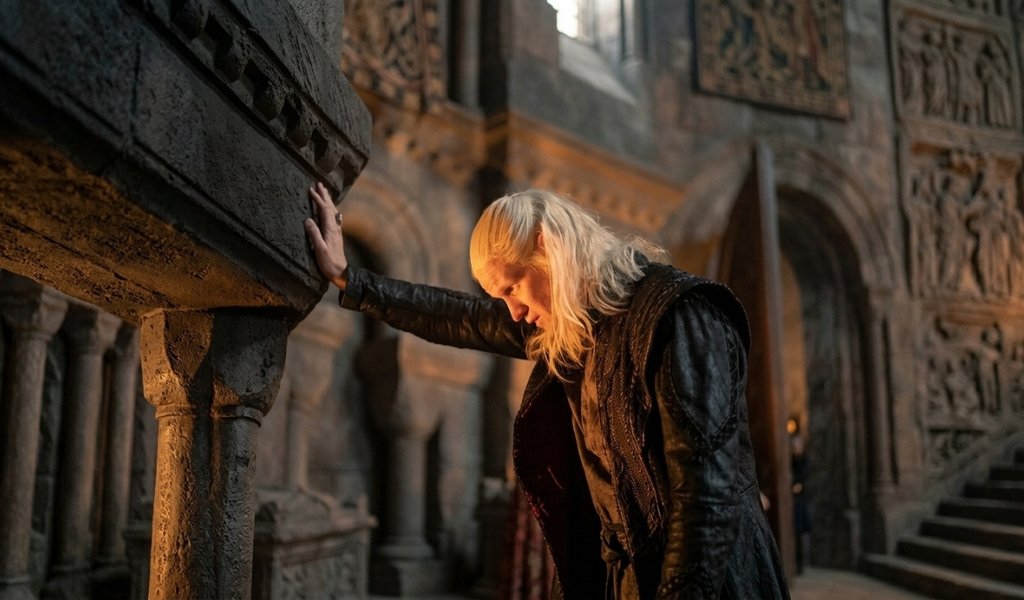
Harrenhal in House of the Dragon sits at the center of the civil war known as the Dance of the Dragons, the bloody succession conflict between Rhaenyra Targaryen’s Blacks and Aegon II’s Greens. By this point, Harrenhal is held by the aging Ser Simon Strong, a cautious man who surrenders the castle without a fight when Daemon Targaryen arrives with his dragon, Caraxes.
Daemon’s occupation of Harrenhal is one of the show’s most psychologically rich storylines. He’s haunted there literally or figuratively, depending on your interpretation. The castle seems to work on him, fraying his certainty, filling his sleep with visions. Even a dragonrider of Daemon’s formidable reputation isn’t immune to the castle’s atmosphere.
Meanwhile, the shadow of House Strong hangs heavily over these events. Earlier in the timeline, Lyonel Strong served as Hand of the King and died in a fire alongside his son Harwin, a fire likely set by Larys Strong, Lyonel’s own younger son, as a political maneuver. The Strongs clawed their way to prominence and were dismantled from within. The castle didn’t need to do anything dramatic. It simply waited.
Harrenhal in Game of Thrones: A Base Built on Rot
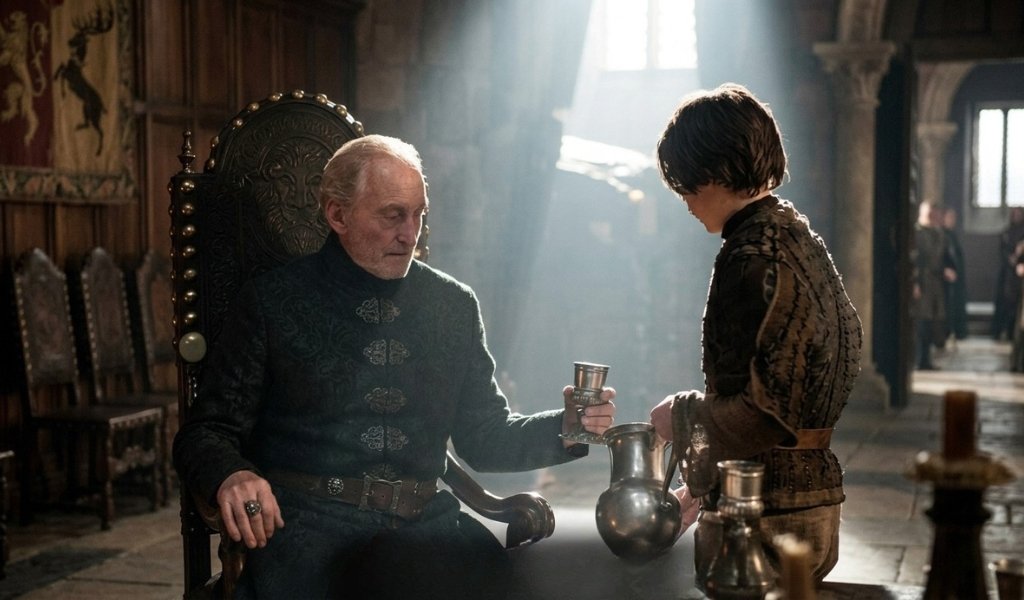
By the time we reach Game of Thrones, Harrenhal has decayed further physically and symbolically. During the War of the Five Kings, Tywin Lannister uses it as a military headquarters, which tells you a great deal about the man. Tywin doesn’t fear curses. He makes them.
Under Lannister occupation, the castle becomes a place of systematic brutality. Prisoners are tortured. Arya Stark arrives as a captive, disguised as a boy, and begins her long education in survival and vengeance. Her time at Harrenhal is formative and there’s a particular irony in the fact that Arya, small and overlooked, cleverly weaponized the superstition of the Harren the Black ghost to cover her assassinations, effectively becoming the real phantom of the castle. Like Harren’s lingering memory, she watches unseen, she manipulates, and she leaves destruction in her wake. The castle seems to amplify the worst impulses of whoever holds it.
Janos Slynt, rewarded with Harrenhal’s lordship by Joffrey Baratheon, never actually rules it a fitting joke for a man who earned his title through betrayal. He’s shipped off to the Wall before he can set foot inside. And then there’s Petyr Baelish, who is granted Harrenhal as part of his climb to power. Littlefinger accumulates titles and schemes, but he never holds Harrenhal in any meaningful sense either. His end comes not in some grand political arena but quietly in Winterfell, executed by the very blade and the girl he underestimated. The castle offers prestige and delivers nothing.
That’s the real nature of the curse, and it may be the most honest thing about it: Harrenhal promises power and strips it away. Harren wanted immortality through architecture. What he got was a monument to the folly of overreach and every lord who has claimed it since has, in some form, made the same mistake.
The Castle Always Wins
Harrenhal isn’t cursed in the way fairy tales describe curses. There’s no witch’s hex, no supernatural mechanism grinding out punishment on a timer. What Harrenhal does is subtler and more devastating. It attracts ambition. It rewards ambition with responsibility too vast to manage, enemies too numerous to outlast, and allies too fragile to trust. The castle outlives everyone.
From Harren the Black burning in his towers to Petyr Baelish dying in a courtyard far from his prize, the pattern holds across centuries and storylines. House of the Dragon and Game of Thrones are separated by roughly 170 years of fictional history, and yet Harrenhal operates exactly the same way in both. That consistency and grinding, unhurried inevitability is what makes the Curse of Harrenhal one of the most compelling threads in George R.R. Martin’s world.
So here’s something worth sitting with: if you were offered Harrenhal, knowing everything you know, would you take it?
Drop your answer in the comments. And if you think one of the houses was wrongly destroyed or that someone could finally break the cycle we’d love to hear your theory.
Frequently Asked Questions (FAQs)
Why was Harrenhal cursed?
Harrenhal is considered cursed due to a dark combination of blood magic, sacrilege during its construction, and its ruinous economic burden. Legends claim that the tyrant King Harren the Black mixed human blood directly into the mortar and chopped down ancient, sacred weirwood trees from the Isle of Faces for timber, drawing the eternal wrath of the Old Gods upon anyone who holds the castle.
Why is Arya called the ghost of Harrenhal?
Arya Stark is called the “ghost in Harrenhal” because she serves as an anonymous, unseen force behind a series of untraceable assassinations inside its walls. While posing as a simple servant, she enlists the mysterious Faceless Man, Jaqen H’ghar, to eliminate her enemies. As people turn up dead without a trace, Arya feels she has become a phantom slipping through the castle’s halls completely undetected.
Why did Larys burn Harrenhal?
In House of the Dragon, Larys Strong secretly burns Harrenhal to orchestrate the brutal deaths of his own father, Lord Lyonel Strong, and his older brother, Ser Harwin Strong. This calculated patricide and fratricide served multiple strategic goals: it allowed Larys to inherit the Strong family titles and castle, cleared the path for Otto Hightower to return as Hand of the King, and cemented Larys’s political alliance with Queen Alicent Hightower.
Why was Harrenhal never fixed?
Harrenhal was never fully repaired because of its astronomical reconstruction costs, absurdly massive scale, and its persistent reputation for being cursed. Because the fortress’s thick stone walls were systematically melted and deformed by Aegon the Conqueror’s dragonfire, restoring it wouldn’t just require a patch-up it would necessitate rebuilding entire colossal towers from scratch, making it a financial impossibility for any noble house in Westeros.