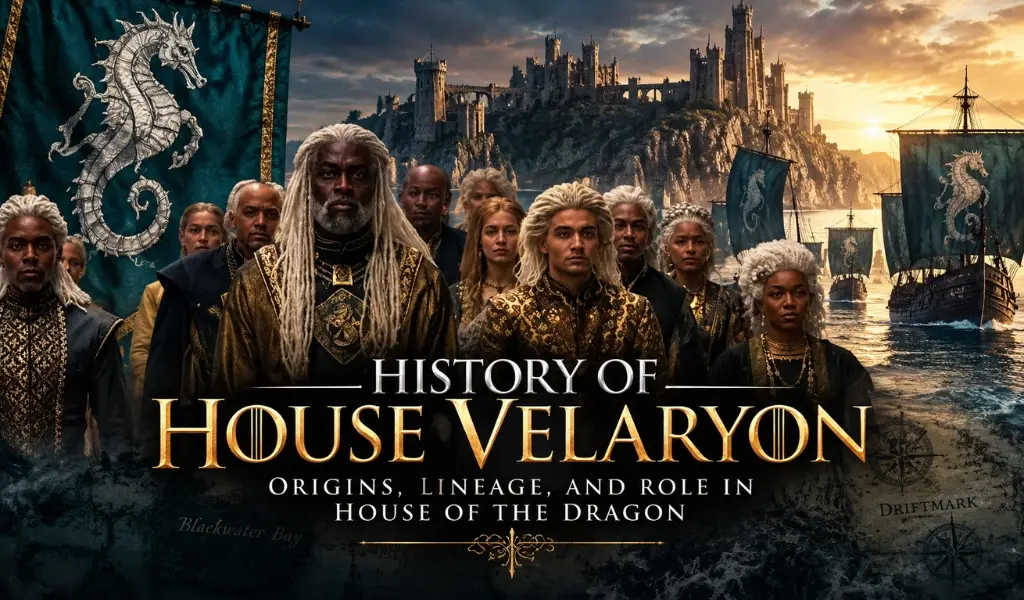

History of House Velaryon: Origins, Lineage, and Role in House of the Dragon
Few families in Westerosi history carry the weight of legacy quite like House Velaryon. Whilst the Targaryens have always claimed the spotlight for their dragons and their infamous silver-haired brutality, House Velaryon has quietly built an empire on the waves, one that predates Aegon’s Conquest and stretches all the way into the bloody Dance of the Dragons. Their story is one of loyalty, ambition, and eventually, devastating loss.
House of the Dragon gives this ancient family the recognition it has long deserved. Set roughly 200 years before the events of Game of Thrones, the series captures House Targaryen at the very height of its power, right before that power fractures into a brutal civil war between siblings. Standing at the centre of that unravelling, alongside House Hightower, is House Velaryon, a family whose fortunes rise and fall with the Targaryens they’ve served for generations.
This is the history of House Velaryon: where they came from, who they married, how they built their fortune, and why, despite their prominence in House of the Dragon, they barely register in Game of Thrones.
Introduction to House Velaryon and Their Valyrian Roots
House Velaryon shares something crucial with House Targaryen: Valyrian blood. That shared ancestry explains the family’s distinctive silver hair and traces back to Old Valyria, long before the Doom reduced that civilization to ash. The Velaryons were allies of the Targaryens even in Valyria, and historians believe they arrived in Westeros well before Aegon and his sisters ever set foot on the continent.
Where the story diverges is in the skies. The Targaryens became dragonlords, commanding the skies with fire and terror. The Velaryons never held that title. Instead, they turned to the sea. Settling on the isle of Driftmark, just off Dragonstone, the family built a reputation as the finest sailors in Westeros, a reputation that would prove indispensable when Aegon the Conqueror needed ships to ferry his soldiers across Blackwater Bay.
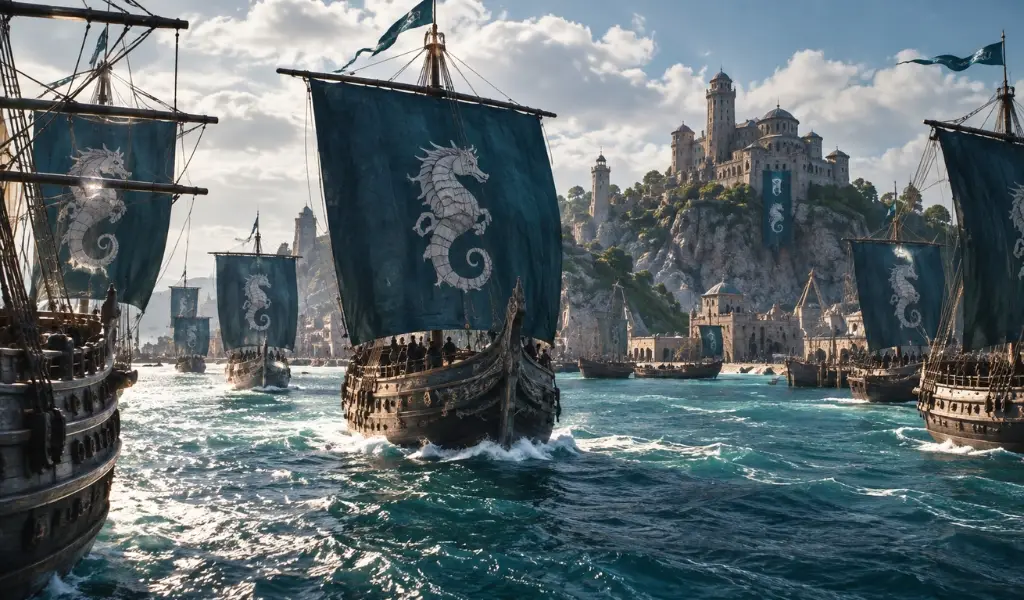
That single contribution cemented a partnership that lasted nearly 200 years. From that point forward, the Velaryons styled the Lords of the Tide became fixtures on the small council, almost exclusively holding the position of master of ships.
House Velaryon History Explained: From Old Valyria to Westeros
Understanding the history of House Velaryon means recognising just how intertwined their fate became with the Targaryen dynasty. While the Targaryens ruled from the Iron Throne, House Velaryon carved out its influence on the water, controlling trade routes, naval power, and crucially access to the rest of the known world.
Their alliance wasn’t purely sentimental. The Velaryons offered something the Targaryens couldn’t replicate: mastery of the seas. In return, they secured proximity to the crown, wealth beyond most noble houses, and repeated intermarriage with the ruling family. It’s a partnership built on complementary strengths: dragons above, ships below and it defined House Velaryon’s identity for centuries.
Overview of House Velaryon’s Family Tree and Lineage
The house Velaryon family tree and lineage stretches back before Aegon’s Conquest itself. Valaena Velaryon, born of an earlier Targaryen-Velaryon marriage, wed Aerion Targaryen and bore three children: Visenya, Aegon (later Aegon the Conqueror), and Rhaenys. Aegon would go on to marry both of his sisters, a detail that underscores just how tightly bound the two families already were.
Around the time of the Conquest, Lord Daemon Velaryon served as master of ships before dying in battle. His two sons split the family’s legacy: Aethon became Master of Driftmark, while his younger brother became the very first Lord Commander of the Kingsguard. Aethon’s daughter, Alyssa, married King Aenys I and became mother to Jaehaerys I Targaryen, widely regarded as Westeros’s greatest ruler. Aethon’s son Daemon succeeded him as Master of Driftmark and later served as Hand of the King to his own nephew, Jaehaerys I.
Daemon Velaryon had three sons Corwyn, Jorgen, and Victor but outlived all of them. Leadership of the house therefore passed to his grandson: Corlys Velaryon, the Sea Snake, the figure at the very heart of House of the Dragon.
Corlys married Rhaenys Targaryen, granddaughter of Jaehaerys I, and the couple had two children, Laena and Laenor Velaryon, both of whom married into House Targaryen. Laena had two daughters with Daemon Targaryen, Baela and Rhaena, while Laenor fathered three sons with Rhaenyra Targaryen Jacaerys, Lucerys, and Joffrey though the show and books strongly imply their true father was Rhaenyra’s sworn shield, Harwin Strong.
After Laenor, Laena, and Rhaenyra’s sons all died, Corlys’s line continued through Addam and Alyn of Hull, two bastards later legitimised as Velaryons. Officially declared Laenor’s sons, they were widely suspected to be Corlys’s own children. Alyn eventually married Baela and served as Master of Driftmark during the reign of Aegon III, “the Broken King.”
Corlys Velaryon: The Sea Snake and His Legendary Voyages
No figure embodies House Velaryon quite like Corlys Velaryon. Known across Westeros as the Sea Snake, Corlys built his fortune and reputation through nine legendary voyages to lands rarely if ever visited by Westerosi sailors.
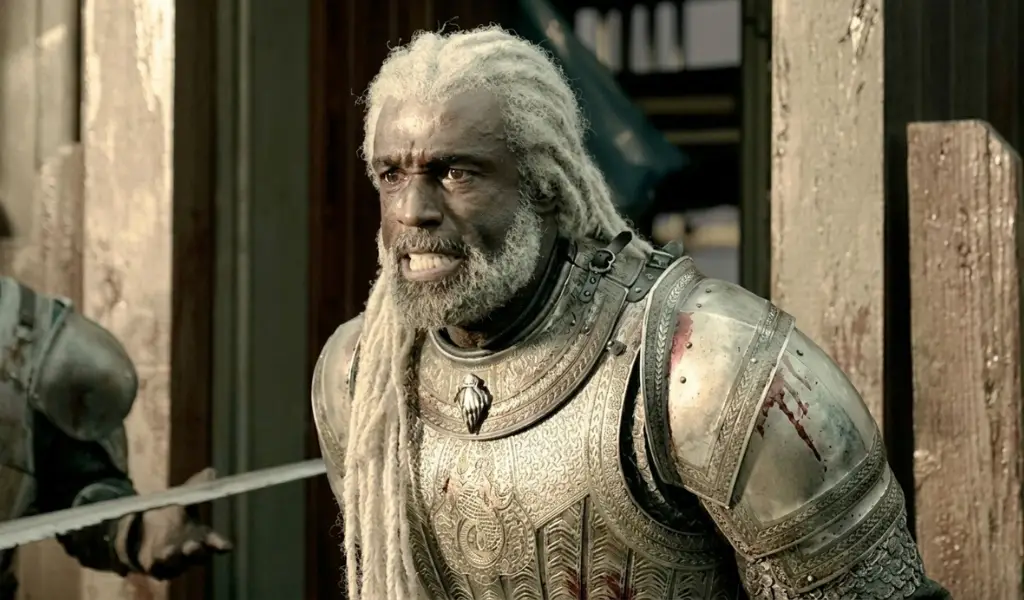
That wealth transformed House Velaryon into one of the richest families in the realm, rivalling even the crown itself.
Corlys’s marriage to Rhaenys Targaryen only strengthened his political standing. Together, they used their combined influence to push for their son Laenor’s claim to the Iron Throne at the Great Council of 101 AC a bid that ultimately failed but signalled just how far Velaryon ambition had grown. Corlys wasn’t content to remain a naval power broker; he wanted a Velaryon-Targaryen line on the throne itself.
Corlys Velaryon Controversy and Adaptation Explained
When casting for House of the Dragon was first announced, House Velaryon’s on-screen adaptation sparked debate. Corlys, his brother, children, and grandchildren are all portrayed by Black or biracial actors, a choice that drew backlash from some corners of the fandom who argued it contradicted the source material.
That argument doesn’t hold up under scrutiny. George R.R. Martin’s Fire & Blood never specifies House Velaryon’s skin colour. The books describe Valyrians as “often” pale, not universally leaving plenty of room for a Black Velaryon family without contradicting canon. Notably, the same critics rarely raised objections when Game of Thrones’ Targaryens appeared without their book-described purple eyes, a far more explicit physical detail than anything written about the Velaryons. Given that Essos was home to a wide range of ethnicities, a Black House Velaryon fits comfortably within Martin’s world rather than against it.
House Velaryon’s Major Role in House of the Dragon
House Velaryon’s storyline in House of the Dragon is inseparable from the fight for the Iron Throne. The series opens with the Great Council of 101 AC, where over a thousand lords gather to choose a successor to Jaehaerys I. Rhaenys, passed over once already in favour of her uncle is overlooked again, despite her and Corlys’s efforts to secure the throne for their son, Laenor. Viserys is ultimately chosen instead.
Still, the two families remain bound together. Laenor marries Viserys’s daughter and heir, Rhaenyra, while Laena marries Viserys’s brother, Daemon. When Viserys I dies, House Velaryon throws its full support behind Rhaenyra Targaryen’s claim over her half-brother Aegon II, setting the stage for the Dance of the Dragons, a war that will cost the family nearly everything.
Valyrian House Velaryon Dragons: Who Could Ride Them?
Despite never being dragonlords historically, several Velaryons ride dragons in House of the Dragon. Laenor and Laena Velaryon both inherited the ability through their mother, Rhaenys Targaryen, herself a dragonrider.
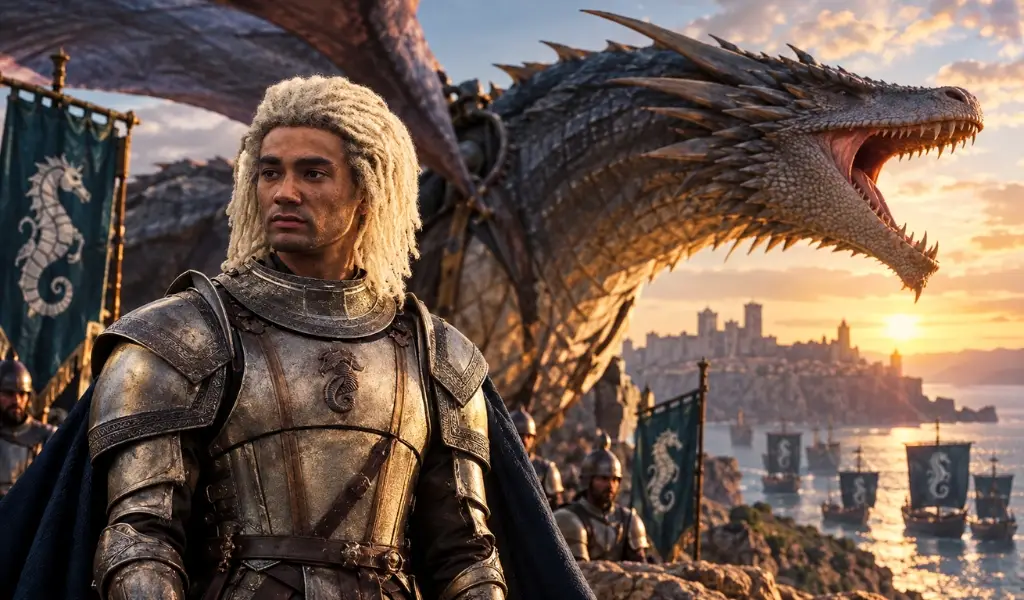
That same lineage passed down to their children: Laenor’s three sons and Laena’s two daughters all rode dragons of their own, a direct consequence of having two dragonrider parents.
Not every dragonriding Velaryon has Targaryen blood, though. Addam Velaryon, widely believed to be Corlys’s biological son, proves himself a “dragonseed” and successfully tames a dragon despite no recent Targaryen ancestry. The exact reason remains unclear, though his Valyrian blood is the likeliest explanation. Had Addam survived to have children, rather than Alyn (who never bonded with a dragon), House Velaryon might have retained its dragonriding legacy longer. As it happened, the dragons died out entirely during Aegon III’s reign regardless.
Velaryon vs Targaryen: Seas vs Skies
At their core, House Velaryon and House Targaryen represent two very different forms of power. The Targaryens rule the skies through fire and dragons; the Velaryons rule the seas through ships and trade. Beyond their shared Valyrian ancestry, the two houses have surprisingly little in common their frequent intermarriage was largely a strategic move by the Targaryens to keep their bloodline “pure.”
Temperamentally, the Velaryons also stand apart. Where the Targaryens are frequently ruthless and volatile, most Velaryons show comparatively little appetite for bloodshed. Part of that likely comes down to ambition, or the lack of a direct one: House Velaryon was never truly vying for the Iron Throne on its own merits. Their power has always been contingent on their closeness to the crown, not a claim to it.
Why House Velaryon Is Not in Game of Thrones
The dragons’ extinction marks the beginning of House Velaryon’s decline. Once that shared Targaryen-Velaryon asset disappeared, the family’s influence, tied so closely to the crown they served, faded alongside it. Corlys’s voyages and personal authority had propped up much of the family’s standing during the Dance of the Dragons; without a leader of his stature, that power was never fully recovered.
By the time Game of Thrones’ timeline arrives, House Velaryon still exists, but it’s a shadow of its former self. With House Targaryen reduced to just two or three surviving members, the Velaryons’ fortunes had clearly diminished alongside them. One notable descendant, Aurane Waters, a Velaryon bastard, briefly served as Cersei’s master of ships in the books, but the character was cut entirely from the show. Much like several other minor Houses, House Velaryon simply didn’t factor meaningfully enough into Game of Thrones’ central plot to warrant screen time.
Final Thoughts on House Velaryon’s Legacy
House Velaryon’s story is ultimately one of rise and ruin, built on an alliance that made them briefly among the most powerful families in Westeros. From Corlys’s legendary voyages to the devastating losses of the Dance of the Dragons, their history offers a compelling parallel to the Targaryens: proof that power built on borrowed strength can vanish just as quickly as it arrived. For anyone diving into House of the Dragon, understanding House Velaryon’s lineage isn’t just background reading it’s essential to understanding the entire war for the Iron Throne.
Frequently Asked Questions
Is House Velaryon related to House Targaryen?
Yes. Both houses trace their ancestry back to Old Valyria and share Valyrian blood, which explains their characteristic silver hair. The two families intermarried frequently over the centuries, partly to preserve the purity of their shared bloodline.
Can House Velaryon ride dragons?
Historically, no House Velaryon was never considered a house of dragonlords. However, several Velaryons with Targaryen parentage, including Laenor and Laena, successfully rode dragons, as did their children. Addam Velaryon also rode a dragon despite lacking recent Targaryen ancestry.
Who is Corlys Velaryon?
Known as the Sea Snake, Corlys Velaryon is the head of House Velaryon during House of the Dragon. He built his fortune through nine famous voyages and married Rhaenys Targaryen, making him one of the most influential figures in Westeros.
Why isn’t House Velaryon in Game of Thrones?
By the time of Game of Thrones, House Velaryon’s power had significantly declined, largely due to the extinction of dragons and the diminished influence of House Targaryen, whom they had always relied upon for status and protection.