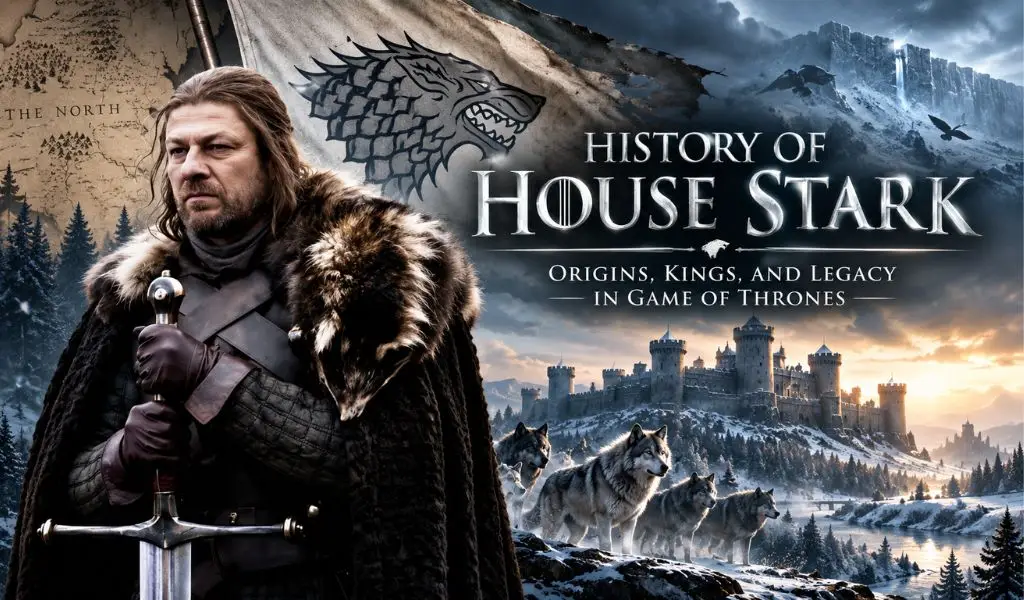

History of House Stark: Origins, Kings, and Legacy in Game of Thrones
Few families in Westeros command the reverence and quiet menace of House Stark. Where other noble houses trade in flattery and schemes, the Starks trade in honour, duty, and an unflinching devotion to the North. Their story spans thousands of years, from the Age of Heroes to the final chapters of Game of Thrones, and it’s a story defined as much by tragedy as it is by resilience.
Understanding the history of House Stark means looking beyond Winterfell’s grey walls and into the deep roots of Westerosi history: the First Men, the Wall, the Kings of Winter, and the brutal wars that nearly wiped the family from the map. This guide traces house Stark origin and ancestry from its legendary founding through to the fates of Ned Stark’s children, exploring what makes this house so central to the world of Game of Thrones.
Who Is House Stark? Honour, Law, and the North
House Stark rules the North from the ancient castle of Winterfell, and their reputation precedes them across the Seven Kingdoms. Unlike many of Westeros’s Great Houses, whose power rests purely on bloodline and title, the Starks earn their standing through sacrifice. Time and again, they place the welfare of the North above personal ambition, and that consistency is what separates them from houses driven by greed or vanity.
Honour, benevolence, and a fierce respect for the rule of law define House Stark’s identity. This reputation is embodied by Eddard “Ned” Stark, who serves as Lord of Winterfell and Warden of the North when Game of Thrones opens in season 1, episode 1, “Winter Is Coming.” Ned holds this position on behalf of his old friend, King Robert I Baratheon, whom he fought alongside in rebellion roughly sixteen years earlier. At Winterfell, Ned lives contentedly with his wife, five trueborn children, and Jon Snow, a son he raises as his own despite the boy’s illegitimate status. It’s a rare moment of stability for the Starks, and Game of Thrones wastes little time dismantling it.
Stark History: Brandon the Builder and the Age of Heroes
To trace house Stark origin and ancestry, you have to go back thousands of years, long before the Seven Kingdoms existed as a unified concept. The Starks descend from the First Men, the same ancestral stock that produced the Wildlings beyond the Wall. This shared lineage is part of what makes the North so distinct from the rest of Westeros, both culturally and politically.
House Stark’s founder was Brandon the Builder, a legendary figure who lived during the Age of Heroes. Also known as Bran the Builder, he’s credited with two of the most significant feats of construction in Westerosi history: raising Winterfell and building the Wall itself. The brandon the builder Winterfell wall connection isn’t incidental it’s foundational to everything the Starks represent. The Wall he constructed would stand for thousands of years, holding back threats from the far north, until the Night King finally breached it in the climactic battle of Game of Thrones season 7.
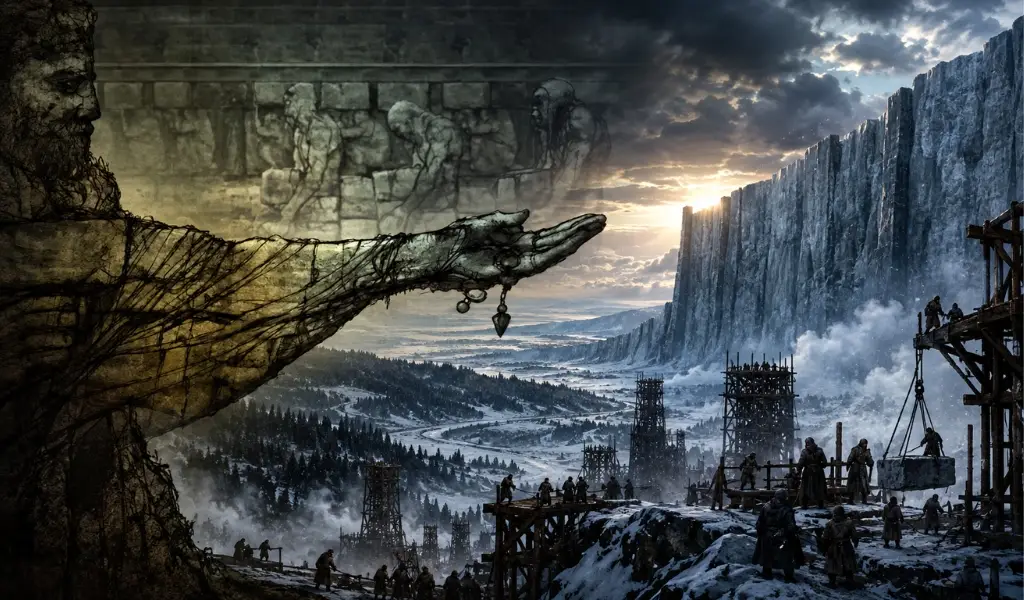
For eight thousand years following Brandon the Builder’s reign, the Starks ruled independently as the Kings of Winter. That era of Northern sovereignty came to an abrupt end when Targaryen dragons arrived in Westeros, forcing even the most stubborn Northern lords to reconsider the cost of resistance.
Torrhen Stark: The King Who Knelt and Targaryen Rule
No figure in Stark history illustrates the tension between pride and pragmatism quite like Torrhen Stark. As the final King in the North, Torrhen faced an impossible choice when Aegon the Conqueror marched north with his army and his dragons. Rather than risk the destruction of his people, torrhen stark the king who knelt chose surrender over slaughter, laying the crown of the Kings of Winter at Aegon’s feet.
History remembers him by that very title the King Who Knelt and for centuries the label carried a sting of shame.
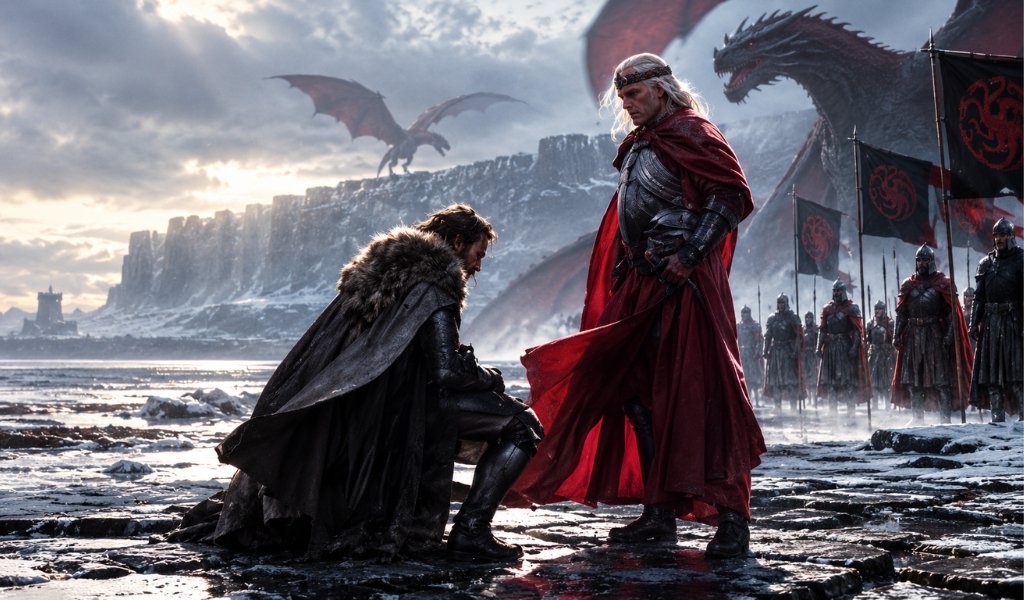
But Torrhen’s decision reflects the same values that define House Stark throughout its history: the North’s wellbeing matters more than personal glory. By submitting to Aegon’s might, Torrhen spared countless Northern lives that a doomed war would have claimed.
Following Torrhen’s surrender, the Starks governed the North as loyal Targaryen vassals, and this period proved to be one of the most prosperous stretches in the Seven Kingdoms’ history. It wasn’t entirely free of conflict, however. Roughly a century after Aegon’s Conquest, the Dance of the Dragons erupted a brutal succession war between Rhaenyra Targaryen, eldest daughter of King Viserys I, and her half-brother. This conflict, later dramatised in House of the Dragon, split the realm. The Starks of the North threw their support behind Rhaenyra, aligning themselves once again with the claimant they believed best served stability over self-interest.
Starks in Game of Thrones: The War of the Five Kings and Tragic Fates
By the time Game of Thrones begins, Ned Stark is married to Catelyn Tully of the Riverlands, and the couple have five children together: Robb, Sansa, Arya, Bran, and Rickon. A sixth child, Jon Snow, is raised alongside them, though Catelyn’s resentment toward the boy simmers throughout the early seasons, a resentment rooted in what she believes to be evidence of Ned’s infidelity. Game of Thrones later reveals a far more complicated truth: Jon is only half-Stark, the son of Ned’s sister Lyanna and the Targaryen prince Rhaegar.
The Starks in Game of Thrones war of the five kings arc marks the beginning of the family’s near-total unravelling. When King Robert rides north to ask Ned to serve as his Hand, Ned reluctantly agrees and travels to King’s Landing with his daughters. The capital proves a poor fit for a man of Ned’s plain honesty; surrounded by manipulation and hidden agendas, he uncovers the truth that Robert’s children aren’t his trueborn heirs. Ned’s attempt to install Stannis Baratheon on the Iron Throne backfires catastrophically. Cersei Lannister and her son Joffrey have him imprisoned and demand that Robb, now heir to Winterfell, bend the knee to the new boy king.
Robb refuses. He raises an army of twenty thousand Northmen, marches south, and eventually declares the North’s independence. That rebellion ends in devastation at the Red Wedding, where Robb, his mother Catelyn, and much of the Northern host are slaughtered by House Frey and House Bolton. Winterfell itself falls into Bolton hands, under Lannister authority, until Jon Snow and his allies reclaim it in Game of Thrones season 6.
Only four of Ned and Catelyn’s children survive the war and its aftermath: Arya, Bran, Sansa, and Jon. They’re eventually reunited at Winterfell just as the conflict beyond the Wall reaches its peak. When the Army of the Dead breaches the Wall, the four Stark siblings stand together to defend the living in the Great War. In the aftermath following the devastating Battle of King’s Landing Bran is elected king by the Great Council, while Sansa secures formal independence for the North, ruling as Queen in the North. Arya sets sail to explore uncharted territory west of Westeros, and Jon is exiled to the Night’s Watch as punishment for killing Daenerys Targaryen.
House Stark Customs, Traditions, and Practices
The house’s stark sigil words and customs reflect a culture shaped by isolation, harsh winters, and deep-rooted tradition. Their sigil is the direwolf, an animal as fierce and loyal as the family it represents, and their words “Winter Is Coming” serve as both a warning and a philosophy. It’s a reminder that comfort is temporary and vigilance is constant.
Death and burial customs at Winterfell reflect the same solemnity. The Starks inter their dead in the crypts beneath the castle, a tradition that binds each generation to the ones before it. Religiously, the Starks follow the Old Gods of the Forest, a polytheistic faith rooted in Northern tradition long before the Andals brought the Faith of the Seven to Westeros. Catelyn Stark, born a Tully of the Riverlands, remains an exception within her adopted family, continuing to worship the Seven throughout Game of Thrones. At the heart of Winterfell’s Godswood stands a Weirwood tree with a face carved into its bark, a place where Ned Stark, and later his son Bran, seek solace and reflection.
Central to Stark identity is the belief that Winterfell must always have a Stark within its walls. That principle has been tested before. House Bolton of the Dreadfort, the so-called Red Kings, once challenged Stark authority in the North, though they were ultimately forced to swear fealty. That old rivalry resurfaces violently in Game of Thrones, when Ramsay Bolton murders his own father, stepmother, and half-brother to seize power, only to be killed himself following the Battle of the Bastards, ending House Bolton’s presence in Westeros entirely.
Why House Stark’s Story Still Resonates
What makes the history of House Stark so compelling isn’t just the scale of tragedy the family endures. It’s the consistency of their values across thousands of years, from Brandon the Builder’s founding legacy to Torrhen Stark’s humbling surrender, and finally to Sansa Stark’s hard-won independence for the North. Each generation faces a version of the same question: how much should honour cost, and is it worth paying?
For readers wanting to dig deeper into Westerosi history, exploring the Dance of the Dragons or the founding of the Night’s Watch offers valuable context for just how far House Stark’s roots extend into the world of Game of Thrones.
Frequently Asked Questions
Who founded House Stark?
Brandon the Builder, also known as Bran the Builder, founded House Stark during the Age of Heroes. He’s credited with raising Winterfell and constructing the Wall.
Why is Torrhen Stark called “the King Who Knelt”?
Torrhen Stark earned this title after surrendering to Aegon the Conqueror rather than risk his army and his people against Aegon’s forces and dragons. He bent the knee, ending eight thousand years of independent Stark rule as Kings of Winter.
What is House Stark’s sigil and motto?
House Stark’s sigil is the direwolf, and their house words are “Winter Is Coming,” reflecting their focus on constant vigilance and preparation.
Which Stark children survive the War of the Five Kings?
Arya, Bran, Sansa, and Jon Snow survive the War of the Five Kings and its aftermath. Robb and Rickon Stark are both killed, while Catelyn Stark dies at the Red Wedding.
What religion does House Stark follow?
The Starks worship the Old Gods of the Forest, a Northern religious tradition tied closely to Weirwood trees. Catelyn Stark is a notable exception, as she continues practising the Faith of the Seven.