
Rhaenyra Cuts Finger on Iron Throne HOTD S3 Episode 6 Explained
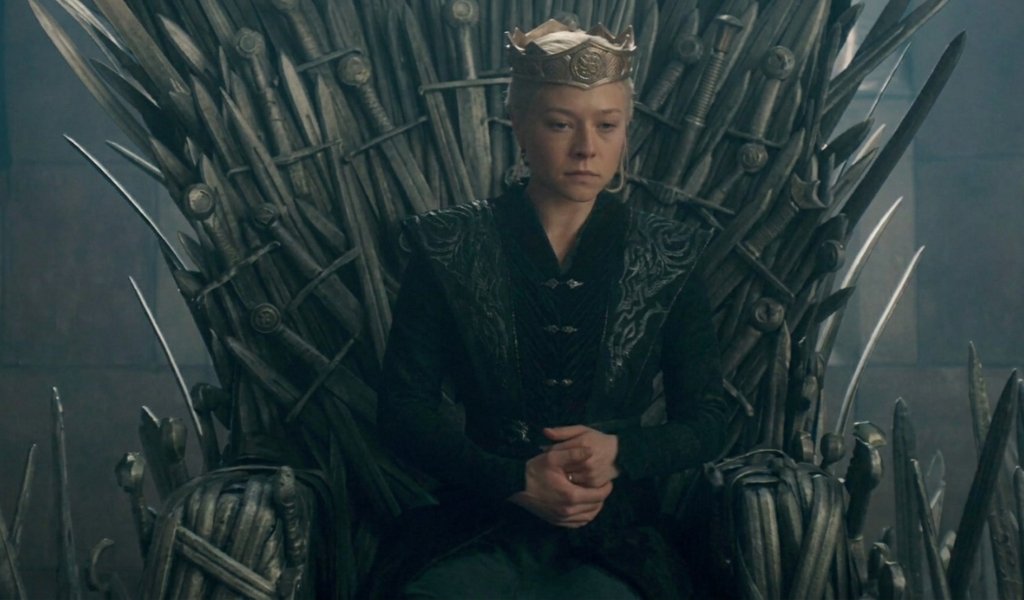
It’s one of the quietest moments in “Faceless Men,” and easily one of the most loaded. Queen Rhaenyra, mid-petition on the Iron Throne, drags her hand across one of its jagged blades. No one in the hall reacts. The camera doesn’t linger. If you blinked, you missed it.
But director Loni Peristere and star Emma D’Arcy both went out of their way to address the moment directly in the episode’s “Inside the Episode” feature, which tells you everything about how deliberate this beat actually was. This wasn’t an accident of blocking. It was a choice.
For TV-only viewers, the cut plays as an ominous flourish in a season already tracking Rhaenyra’s grip on power slipping. For readers of George R.R. Martin’s Fire & Blood, it lands differently, because Martin handled this same image on the page and handled it with a lot more ambiguity than the show allows. Here’s what the scene means, why it echoes further back into the show’s own history, and how the book’s version quietly complicates everything the show wants you to feel.
The Scene: Rhaenyra Cuts Her Finger on the Iron Throne in HOTD Season 3 Episode 6
The setting is almost aggressively mundane. Rhaenyra sits the Iron Throne in “Faceless Men,” hearing petitions from the smallfolk the unglamorous, day-to-day work of actually running a kingdom rather than fighting for one. It’s in this ordinary moment, not a battle or a betrayal, that the throne draws blood.
The cut itself is small. No swelling music, no reaction shot, no dramatic close-up milking the moment for tension. The episode’s restraint is exactly what makes it land. Instead of announcing itself as a Big Symbolic Moment, the scene lets the wound pass almost unnoticed which, thematically, is the whole point.
Without Peristere and D’Arcy spelling it out afterward, plenty of casual viewers likely scrolled right past it. That’s by design. The show is betting that the moment will register subconsciously first, and only crystallize into meaning once you know what to look for.
Infection and Rot: What the Cut Really Means for Rhaenyra’s Reign
Peristere’s own description of the scene centers on the idea of infection a small wound left untreated that spreads and worsens over time. He’s framed the cut as the moment that reveals what’s already quietly rotting through Rhaenyra’s court: her small council, the City Watch, the streets of King’s Landing itself, all fraying in ways that mirror a wound nobody’s bothered to clean.
Emma D’Arcy’s read on the character adds an important wrinkle. Rhaenyra isn’t shown clocking this as some supernatural omen. She experiences it, per D’Arcy, as one more piece of a broader hostility closing in around her reign a queen sensing that things are going wrong without necessarily believing the throne itself is passing judgment. That gap between what Rhaenyra feels and what the audience is meant to infer is where the scene gets its power.
Structurally, Peristere has described the cut as an instigating event, the kind of small threshold-crossing that sets bigger consequences in motion. That’s a meaningful distinction: not a prophecy being delivered, but a hinge the story quietly turns on.
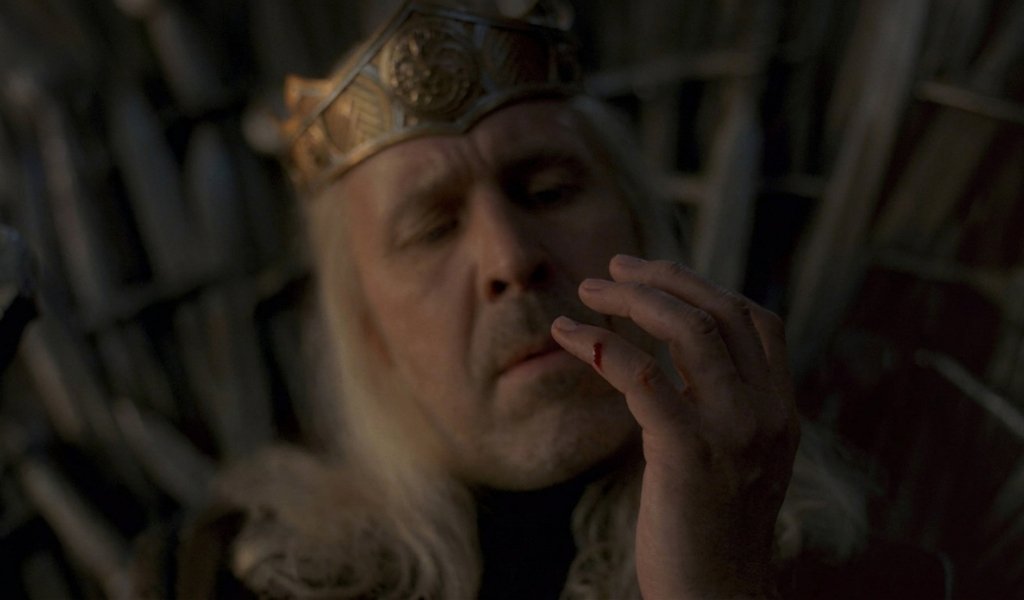
It’s also not the first time the show has used this exact visual language. Season 1 built an entire arc around Viserys I bleeding on this same throne, his wounds worsening in step with his failing grip on the realm. Season 3 is clearly inviting you to draw the line between the two reigns yourself.
The Iron Throne’s Curse: Why It Rejects Unworthy Rulers
To understand why a cut carries this much weight, it helps to remember what the Iron Throne actually is. Aegon the Conqueror had it forged from the swords of every enemy he defeated a seat built from conquest and dominance, never designed with comfort or safety in mind. Every blade left jutting from its surface is, in a sense, still doing the job it was made for.
Over generations, Westerosi superstition has grown around exactly this danger. The throne is said to actively judge the people who sit on it, drawing blood from rulers it deems unworthy and leaving the deserving untouched. Two Targaryen kings define the pattern most vividly:
- Viserys I wounds from the throne that never properly healed, growing infected in a slow decline that mirrored the unraveling of his reign.
- Aerys II, the Mad King cut so often and so badly that he earned the grim nickname “King Scab.”
Whether or not the throne is literally cursed, House of the Dragon leans hard into this folklore as a storytelling device. Rhaenyra’s cut functions as a bad omen within that symbolic vocabulary, regardless of whether anything supernatural is actually happening. And per D’Arcy, Rhaenyra herself may not even be making the connection to her father’s fate which only sharpens the dramatic irony for anyone watching who remembers exactly how his story ended.
Show vs. Book: Fire & Blood’s Ambiguous Superstition vs. HOTD’s Explicit Symbolism
Here’s where the show and the source material genuinely part ways. House of the Dragon treats the throne’s judgment as more or less real within its world. Fire & Blood treats it as unreliable legend, filtered through biased narrators who weren’t exactly neutral observers of the events they’re describing.
The book’s account comes from Septon Eustace, who writes that “the Iron Throne had spurned her, and her days upon it would be few”. That line matters less as a statement of fact and more as a snapshot of one chronicler’s spin Martin’s history is built from competing, often self-serving accounts, and the throne’s “rejection” of Rhaenyra reads as retrospective myth-making by people writing after they already knew how her reign ended.
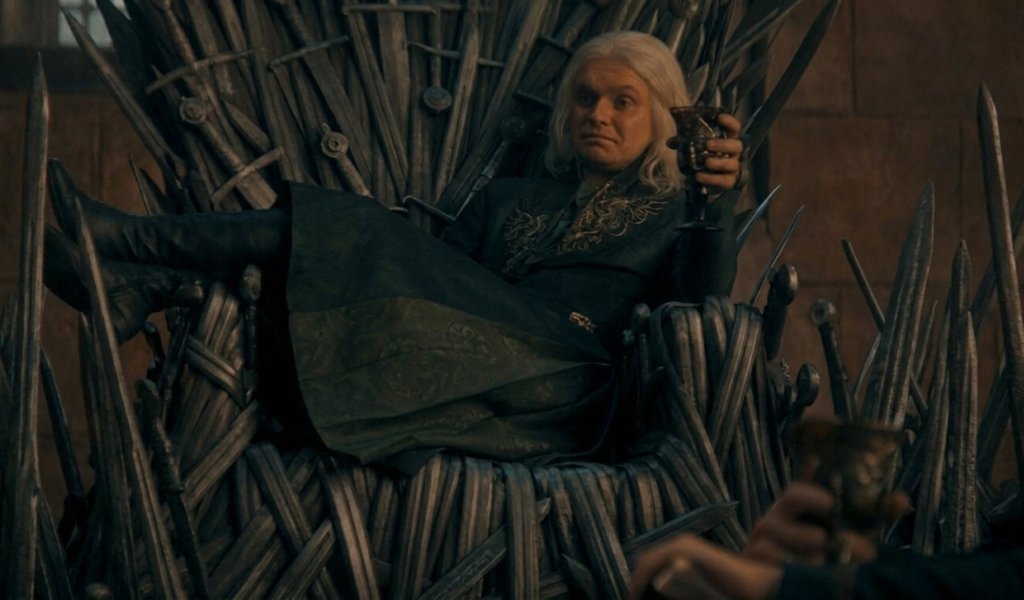
The show makes a very different choice: it stages Rhaenyra bleeding while Aegon II sits the same throne without a scratch, which effectively confirms the superstition as literal fact inside the show’s world. That’s a striking visual, but it comes with a cost. By making the curse legible and concrete, the show quietly reframes Rhaenyra’s downfall as something closer to fate than to the accumulation of human choices, alliances, betrayals, and battlefield losses that actually define her arc in the books.
It’s worth remembering, too, that there’s a mundane explanation sitting right there in plain sight. Rhaenyra has spent hours armored and gripping an unforgiving iron seat after suffering catastrophic personal losses. A small cut under those conditions needs no curse to explain it and Martin’s text quietly leaves room for exactly that reading.
None of this makes the show’s choice wrong, exactly. It’s a trade-off. House of the Dragon gains a striking, reusable visual motif it can call back to across seasons. What it loses is some of the moral and historical murkiness that makes Fire & Blood so compelling in the first place the sense that history is written by whoever’s left standing, not handed down by a sentient throne.
Conclusion: Blood on the Throne, Meaning in the Gap
Taken on its own, the cut in “Faceless Men” is genuinely well-built television understated, patient, and made sharper by Peristere and D’Arcy’s commentary afterward rather than dependent on it. But the more interesting story is in the gap between the two versions: House of the Dragon uses the Iron Throne as an active symbol of judgment, while Fire & Blood uses it as a mirror for how history gets rewritten by the people who survive to tell it.
Whether you read Rhaenyra’s cut as doom foreshadowing, political metaphor, or a bit of both, it’s worth another watch with Peristere’s framing in mind.
So, over to you: does the show’s more explicit, fated version of the Iron Throne’s curse strengthen Rhaenyra’s tragedy or does it flatten the ambiguity that makes her story hit so much harder on the page? Drop your take in the comments.
Frequently Asked Questions
House of the Dragon Season 3, Episode 7 release date?
House of the Dragon Season 3, Episode 7 will release on August 2, 2026, on HBO and streaming on Max at 9:00 p.m. ET, with international streaming times varying into early Monday morning (such as August 3).
