

Who Killed Criston Cole in House of the Dragon?
Ser Criston Cole spent three seasons making enemies. By the time House of the Dragon Season 3 Episode 6 arrived, viewers knew his end was coming. What they didn’t expect was how abrupt and, for book readers, how frustratingly incomplete that ending would be.
So, who killed Criston Cole? The short answer: Alysanne Blackwood, a fierce archer from the Riverlands, cut him down with a volley of arrows during the ambush at the Butcher’s Ball. But the longer answer is far more interesting and far more complicated.
Whether you watched the scene with your jaw on the floor or your fists clenched in disappointment depends entirely on how well you know George R.R. Martin’s Fire & Blood. Either way, Cole’s death is one of the most talked-about moments of the season. Here’s a full breakdown of what happened, who was responsible, and why the show’s version left so much on the table.
The Climax at Harrenhal: Criston Cole’s Death at the Butcher’s Ball
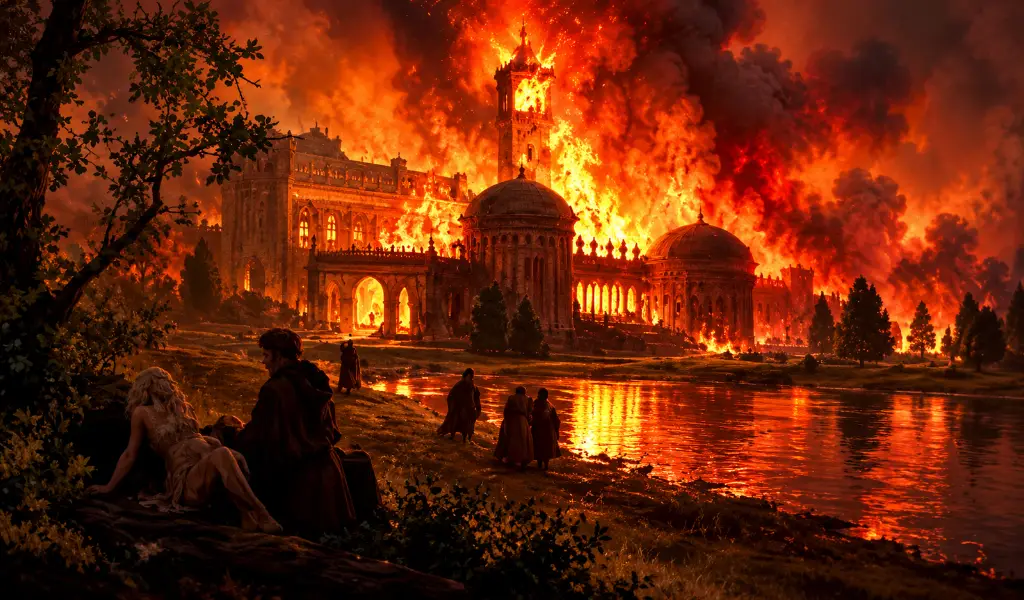
The Criston Cole death Butcher’s Ball HOTD scene is constructed as a double trap. Cole and his remaining forces arrive at an eerie scene of bodies scattered across the ground, no clear explanation for how they got there. While Cole’s men investigate, they’re ambushed by a hidden group of soldiers.
They fight them off. Then they realize it was a distraction.
A second, far larger force has them completely surrounded. Riverlands and Northern soldiers close in on all sides, and Cole, his army decimated, his options exhausted, finally grasps that there’s no fighting his way out of this one.

Cole’s Last Gambit: Single Combat Against Roddy the Ruin and Oscar Tully
Cornered but unbroken, Cole attempts a parlay. He proposes single combat: himself against both Roddy the Ruin (Tommy Flanagan) and Oscar Tully (Archie Barnes) at once. A three-way duel. It’s a bold, almost theatrical offer but it fits perfectly with the version of Cole that the show has built across three seasons.
In an earlier episode, Cole confided in Gwayne Hightower (Freddie Fox) that he considers himself the finest fighter in the realm. He told Hightower that if death found him, he wanted it to mean something. “They’ll sing songs of it,” he boasted. The parlay proposal is Cole being entirely consistent: even facing annihilation, he’s angling for legend.
The enemy commanders never get the chance to respond.
The Deadly Arrow: Who Killed Criston Cole in House of the Dragon Season 3?
Before Roddy the Ruin or Oscar Tully can answer his challenge, Cole is struck by multiple arrows. He crumples suddenly, quietly, without ceremony and the camera shifts to reveal his killer: a woman in striking dark makeup, smirking from the tree line.
That woman is Alysanne Blackwood. The Alysanne Blackwood Criston Cole death moment lands with visual impact, but the show stops there. Her name is never spoken. Her backstory is never mentioned. She appears, she kills, and she vanishes back into the background.

Why Alysanne Blackwood Matters And Why the Show Failed to Show It
In George R.R. Martin’s Fire & Blood, Alysanne Blackwood is not a nameless silhouette. She’s a skilled archer with a personal stake in the war, a woman driven, in part, by a desire to avenge her brother’s death. Her presence at the Butcher’s Ball is purposeful. Her role in ending the Kingmaker’s life carries narrative weight precisely because she has been established as a character with history and motive.
The show had already done the costume work. The visual design of the character is striking enough that she clearly wasn’t meant to be a background extra. Yet without a name drop, without a line of dialogue, without even a title card, most viewers watching Season 3 Episode 6 had no idea they had just witnessed a moment that book readers had been anticipating for years.
Book vs. Show: Ser Criston Cole’s Death in Fire & Blood vs. House of the Dragon
The gap between the source material and the adaptation is clearest when you look at what’s missing specifically, one line.
In Fire & Blood, Cole makes the same desperate proposal for single combat. He’s immediately silenced by the archer who ends his life, who says: “I’ll have no songs about how brave you died, Kingmaker. There’s tens o’ thousands dead on your account.”
That line does everything. It reframes Cole’s death not as a glorious last stand but as a reckoning. It refuses to let him have the legend he wanted. It names him by his most contemptible title Kingmaker and holds him accountable for the cost of the Dance of the Dragons in a single breath. And it gives Alysanne Blackwood a voice, a purpose, and a place in the story’s memory.
The show cut all of it.

What makes this omission so frustrating isn’t that the writers changed the source material adaptation always involves changes. The frustration is that the setup was already there. Season 3 spent real screen time establishing Cole’s obsession with a glorious death. The “they’ll sing songs of it” line was practically a cue card. The writers had already laid the perfect foundation for Blackwood’s rebuttal to land with maximum force. They simply chose not to use it.
Copying that line from the book and placing it in Blackwood’s mouth would have cost nothing. Instead, Cole dies holding Alicent’s handkerchief a quiet, melancholy image while the woman who killed him remains an unidentified stranger.
The Legacy of the Kingmaker’s End
Criston Cole was never meant to be mourned. Across three seasons, Fabien Frankel played him as a man corroded by grievances spurned, weaponized, and ultimately consumed by the system he served. The show did genuine work in building that portrait of resentment and misplaced loyalty.
His death at the Butcher’s Ball is, structurally, the right ending. The manner of it ambushed, outnumbered, denied the heroic fight he craved fits the thematic logic of his arc. The Kingmaker spent his career manufacturing conflict for lords who saw him as disposable. He dies in exactly the kind of chaos he helped create.
The problem isn’t the death itself. The problem is the execution. Alysanne Blackwood deserved to be introduced properly. She deserved to speak. Cole deserved a death scene that fully closed the loop the show itself had opened. Book fans weren’t asking for a verbatim recreation, they were asking for the meaning of that iconic line to survive the translation from page to screen.
Two episodes remain in Season 3. There’s a slim chance Blackwood returns and the show fleshes out who she is. But no amount of retroactive characterization changes what happened in that moment. The Kingmaker is dead. His legacy is complicated. And the scene that should have defined his ending will be remembered, at least by those who read the books, for what it chose to leave out.
Frequently Asked Questions
Who shot Criston Cole?
Ser Criston Cole is shot and killed by Alysanne Blackwood in the television series adaptation, while the books credit Red Robb Rivers.