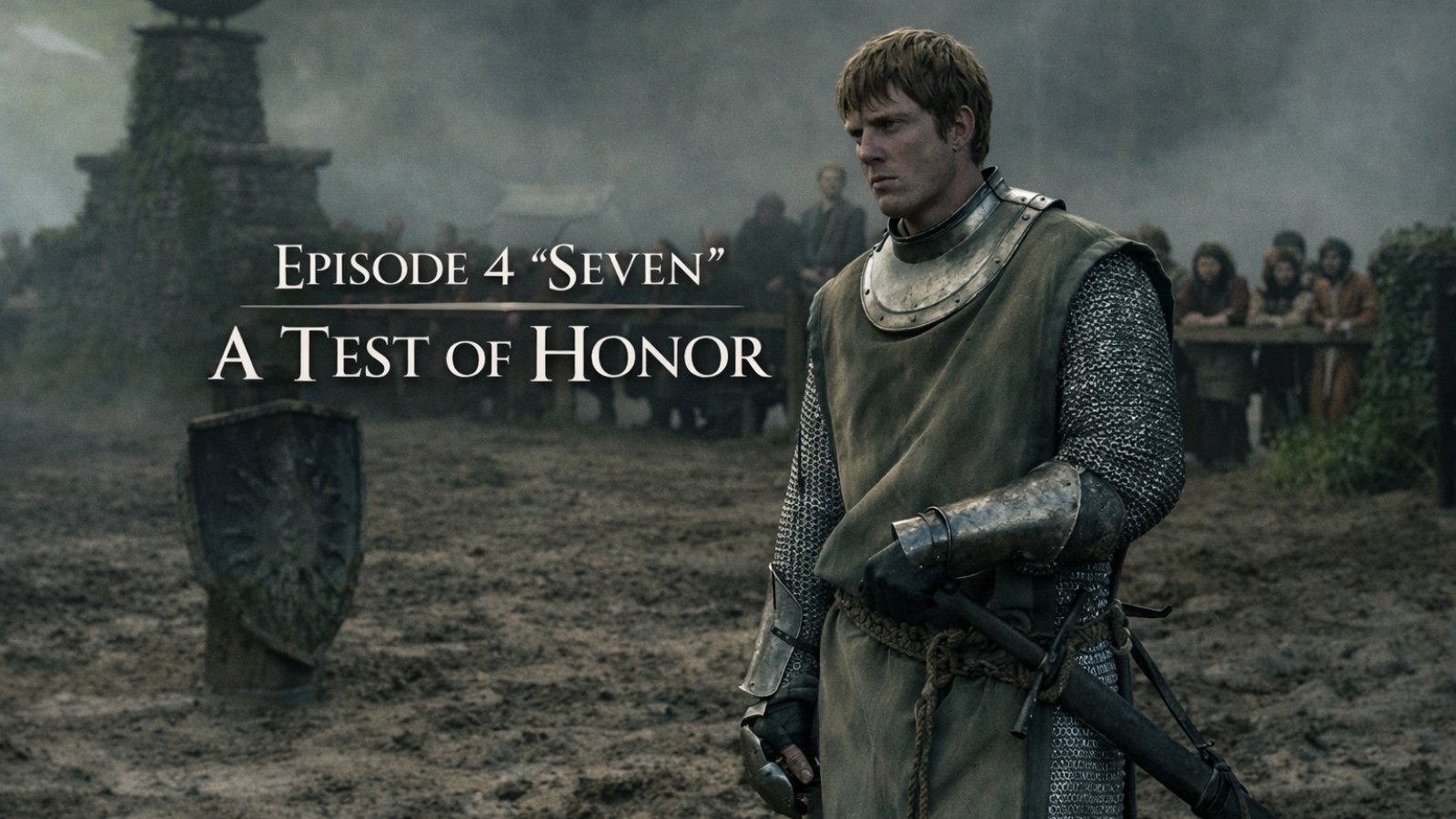

Why A Knight of the Seven Kingdoms Episode 4 “Seven” Defines True Knighthood
A Knight of the Seven Kingdoms Episode 4 Seven stands as the moral and thematic core of the series. Episode 4, titled “Seven,” avoids spectacle and shock, instead proving why this adaptation understands the heart of George R. R. Martin’s The Hedge Knight better than most television fantasy.
For viewers searching for A Knight of the Seven Kingdoms Episode 4 Seven explained, this chapter is far more than a simple recap or episode summary. It is a literary and thematic examination of honour, choice, and identity, asking what knighthood truly means once titles, armour, and ceremony are stripped away.
More than any other chapter so far, “Seven” shows that being faithful to The Hedge Knight Seven adaptation is not about copying every page, but about understanding its soul.
Key Takeaways
- A Knight of the Seven Kingdoms Episode 4 Seven functions as the moral foundation of the series
- The episode balances book accuracy with meaningful adaptation choices
- The Trial of Seven episode explained reveals power versus principle
- Dunk’s actions redefine the meaning of a true knight
- Baelor Breakspear trial of seven delivers the episode’s central message
Books vs Show: How Faithful Is Episode 4 “Seven”?
When discussing Episode 4 Seven books vs show, accuracy alone does not tell the full story. This episode closely adapts pages 78–100 of The Hedge Knight, preserving much of the dialogue, structure, and emotional beats.
However, the strength of this A Knight of the Seven Kingdoms Episode 4 book comparison lies in how the show reshapes moments rather than reproducing them exactly.
Several conversations are shortened, certain characters are re-positioned, and small omissions subtly change the tone. These Seven episode book changes are not losses. They sharpen the narrative focus, keeping attention fixed on Dunk’s moral struggle rather than expanding the surrounding lore.
This is why many fans now consider “Seven” one of the most faithful adaptations in spirit, even when specific details differ from the book.
Dunk and Egg in the Cell: A Quiet Moral Turning Point
One of the most important scenes in A Knight of the Seven Kingdoms Episode 4 Seven is the opening exchange between Dunk and Egg Episode 4, set inside the cell.
In the book, the conversation feels warmer and more explanatory. In the show, it is colder and restrained. Dunk is harsher. Egg is more exposed. The imbalance of power is clearer.
This shift re frames their relationship. Dunk is no longer simply a protector. He is confronting the cost of standing by his vows. This Episode 4 book comparison highlights how responsibility replaces comfort.
The scene quietly poses the episode’s central question:
Is knighthood about kindness, or about choosing what is right when kindness is no longer enough?
The Trial of Seven Episode Explained: Power Versus Principle
The Trial of Seven episode explained reveals the moral architecture of Episode 4. Rather than presenting the trial as a legal custom, the show frames it as a test of courage and conviction.
Prince Aerion trial of seven is not about justice. It is about domination. Numbers replace fairness. Tradition becomes a weapon.
While the book details the mechanics differently, the show simplifies the setup to focus on why the trial exists, not how it is arranged. This clarity makes the trial feel unavoidable rather than procedural.
The result is a confrontation between power and principle, with Dunk standing alone against both.
Daeron Targaryen’s Prophecy and What the Show Changes
Among the most discussed changes in The Hedge Knight Seven adaptation is Daeron Targaryen prophecy.
The show adds imagery absent from the book, particularly the reference to fire. While the novella frames Daeron’s visions as deeply personal fears, the episode broadens their implications.
Rather than foreshadowing specific events, the scene reinforces a central idea within A Song of Ice and Fire themes chivalry: knowledge without courage becomes its own form of tragedy.
Daeron’s presence deepens the episode’s philosophical weight without overwhelming its narrative focus.
“Are There No True Knights Among You?” Meaning Explained
Dunk’s speech represents the emotional axis of A Knight of the Seven Kingdoms Episode 4 Seven.
For viewers searching Are there no true knights among you meaning, the answer is found in the silence that follows.
The line is not a challenge to rank or skill. It is an accusation aimed at inaction. The episode deliberately offers false hope, allowing mockery to replace response.
This pause forces the audience to share Dunk’s despair, reinforcing the idea that honour often stands alone before it is answered.
Baelor Breakspear and the Trial of Seven Climax
In A Knight of the Seven Kingdoms Episode 4 Seven, the entrance of Baelor Breakspear transforms the episode’s meaning.
In discussions about Baelor Breakspear scene explained, this moment stands out not for spectacle, but for restraint. Baelor does not assert authority or demand attention. He responds to a moral call.
His choice re frames the entire Trial of Seven, proving that knighthood is not inherited, declared, or proven through victory.
It is chosen.
Why Episode 4 “Seven” Is the Moral Heart of the Series
Among all episodes so far, A Knight of the Seven Kingdoms Episode 4 Seven serves as the ethical foundation of the series.
It confirms that this story is not about tournaments, bloodlines, or destiny. It is about individuals deciding who they are when no one is watching and when standing up carries real consequences.
By balancing books vs show Seven with thoughtful interpretation, Episode 4 becomes more than a faithful retelling. It becomes a definition of true knighthood.
Final Thoughts
A Knight of the Seven Kingdoms Episode 4 Seven avoids shock, excess violence, and spectacle.
In comparing books vs show Seven, the episode proves that the strongest adaptations are not those that replicate every line, but those that understand why those lines mattered.
“Seven” does not simply adapt The Hedge Knight.
It honours it.