
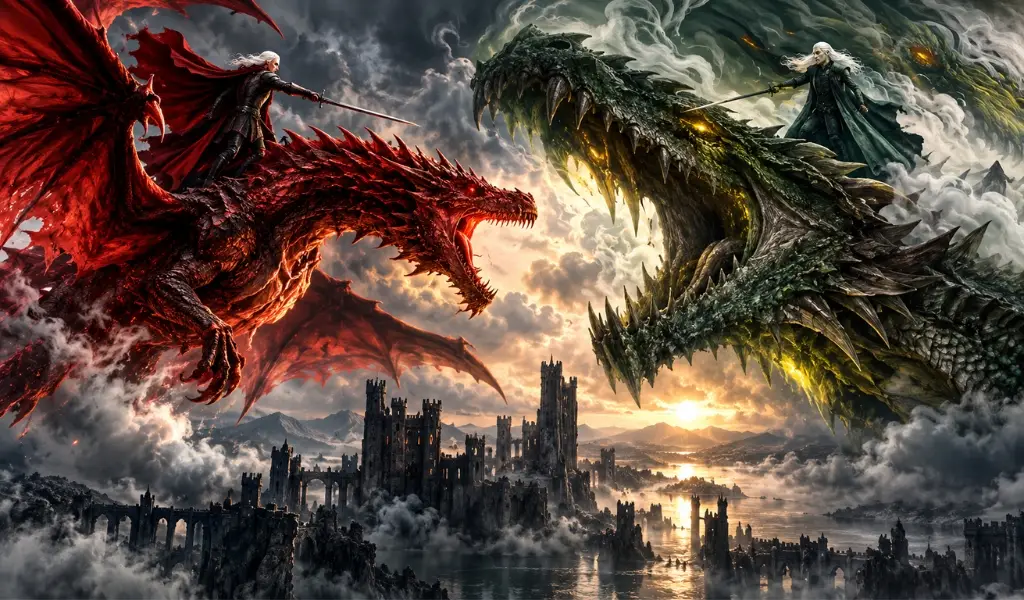

Battle Above The Gods Eye: Daemon and Aemond’s Fatal Duel
The Battle Above the Gods Eye is the climactic dragon duel from House of the Dragon’s Dance of the Dragons, pitting Prince Daemon Targaryen and Caraxes against Prince Aemond Targaryen and Vhagar over Harrenhal in 130 AC. The fight ends with Daemon driving his Valyrian steel sword, Dark Sister, into Aemond’s blind eye socket, killing all four combatants, two princes and two dragons in a single, devastating clash.
Few moments in House of the Dragon carry as much weight as the Battle Above the Gods Eye. It’s the confrontation the entire Dance of the Dragons has been building toward: two Targaryen princes, bound by blood and broken by ambition, finally meeting in the sky above Harrenhal. What makes this duel so gripping isn’t just the scale of the dragonfire it’s the tragic inevitability of it. Daemon and Aemond were always circling each other, and the Gods Eye is where that orbit finally collapsed.
This piece breaks down the Battle Above the Gods Eye explained in full: the political maneuvering that set it in motion, the duel itself, and why Daemon and Aemond function as mirror images of one another throughout the Dance of the Dragons.
What Led to the Battle Above the Gods Eye?
How did Aemond’s terror campaign in the Riverlands start the conflict?
Once King’s Landing falls to the Blacks, Queen Rhaenyra Targaryen sends Daemon, his dragon Caraxes, and the Dragonseed Nettles rider of the wild dragon Sheepstealer to the Trident. Their mission: stop Aemond’s campaign of terror sweeping across the Riverlands. Operating out of Maidenpool, the seat of House Mooton, Daemon and Nettles search the Trident together for any sign of Aemond and his dragon Vhagar.
During this hunt, the two riders grow close. Court Jester Mushroom claims Daemon and Nettles become lovers, though Archmaester Gyldayn disputes this, citing Maester Norren’s Chronicles of Maidenpool. Norren records only that “the prince and his bastard girl” slept in rooms next to one another, and that Daemon effectively became Nettles’ foster father during their time at Maidenpool. Whatever the truth, their bond becomes a flashpoint back at Rhaenyra’s court.
Why did Rhaenyra turn against her own Dragonseeds?
Daemon, Nettles, Ulf White, Hugh Hammer, and Addam of Hull the four Dragonseeds had already proven their worth at the Battle of the Gullet and during the Fall of King’s Landing. But loyalty among dragonriders of common blood proves fragile. Ulf White (riding Silverwing) and Hugh Hammer (riding Vermithor) defect to the Greens during the First Tumbleton, helping sack the town and throwing Rhaenyra’s court into chaos.
The betrayal shatters Rhaenyra’s trust in her remaining Dragonseeds. Mysaria, acting as her unofficial Mistress of Whisperers, seizes the moment. She feeds Rhaenyra accusations against Nettles’ claims of misconduct at Maidenpool and an alleged affair with Daemon. Paranoid and isolated, Rhaenyra writes to Lord Manfryd Mooton with an order: execute Nettles. She also summons Daemon back to King’s Landing.
Manfryd, more afraid of Daemon’s wrath than Rhaenyra’s authority, refuses to carry out the execution and instead brings the letter to the prince. Daemon responds by helping Nettles escape on Sheepstealer. Meanwhile, Aemond continues burning his way through Stonyhead, the Mountains of the Moon, and Sweetwillow. The same day Nettles flees, Daemon sets out for Harrenhal no longer chasing orders from his queen, but chasing Aemond himself.

What Happens During the Battle Above the Gods Eye?
How does Daemon challenge Aemond to a duel at Harrenhal?
Daemon’s pursuit of Aemond sets the stage for one of the deadliest dragon battles of the entire Dance of the Dragons, a fight that ultimately claims all four combatants. It marks the brutal endpoint of Aemond’s Riverlands campaign. Daemon arrives at Harrenhal first and waits. Aemond shows up a fortnight later, accompanying his pregnant paramour Alys Rivers. Before the duel, Aemond kisses Alys goodbye and exchanges a few final words with his uncle. Then both princes mount their dragons as dusk settles over the Gods Eye, and the Battle Above the Gods Eye begins.
Quick facts: Battle Above the Gods Eye
- Timeline: 130 AC
- Preceded by: Fall of Dragonstone
- Succeeded by: Storming of the Dragonpit
- Combatants: Aemond Targaryen vs. Daemon Targaryen
- Dragons: Aemond’s Vhagar vs. Daemon’s Caraxes
- Location: The Gods Eye Lake, with Harrenhal on the north shore
- Casualties: All four combatants
What happens when Vhagar and Caraxes fight above Harrenhal?
Alys Rivers watches the entire battle unfold from Harrenhal’s Kingspyre Tower. Despite Vhagar’s immense size advantage, Daemon and Caraxes hold their ground against Aemond and Vhagar. Dragonfire tears across the night sky over the Gods Eye as the two beasts clash with Caraxes striking at Vhagar’s neck, Vhagar retaliating at Caraxes’ belly. It’s a vhagar vs caraxes harrenhal battle fought at full scale, dragon against dragon, with no clear advantage on either side.
How does Daemon kill Aemond with Dark Sister?
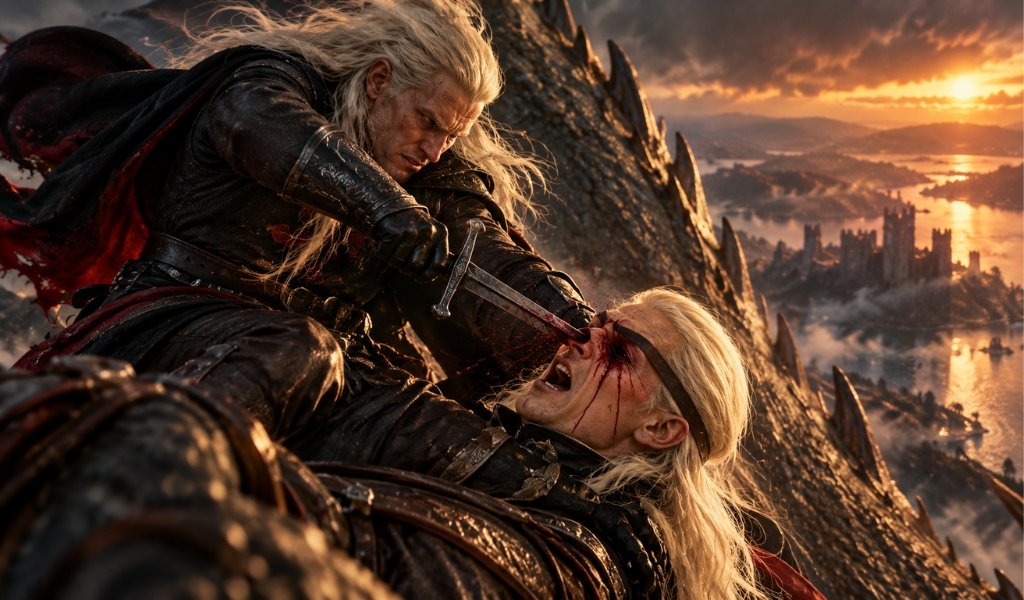
The duel reaches its breaking point when Daemon makes a desperate, decisive move: he leaps from his own dragon saddle onto Vhagar and drives his Valyrian steel sword, Dark Sister, directly into Aemond’s empty eye socket, the same eye Aemond lost earlier in the war. The strike is fatal. The fall that follows kills all four combatants: Daemon, Aemond, Caraxes, and Vhagar. Choose to read this moment as poetic justice if you like Aemond loses his life through the very wound that shaped his cruelty but lore-accurate or not, the outcome reshapes the entire Dance of the Dragons. With Vhagar destroyed, the Greens lose their single greatest military asset, tipping the balance of power for the rest of the war.
How Are Aemond and Daemon Mirror Characters?
House of the Dragon spends two seasons quietly building Daemon and Aemond as reflections of one another, and the parallel pays off precisely because it’s earned. Both are the realm’s second sons, meaning neither was ever meant to inherit the throne. Both share near-identical hairstyles. Both pursue knowledge and power with the same obsessive drive. And both share a fluency in High Valyrian that sets them apart from most of their Targaryen kin.
Choose to see Aemond as Daemon’s successor, and the early Dance of the Dragons supports it: as the war begins, both princes set out to secure alliances. Aemond flies to Storm’s End, while Daemon seeks an audience with Lord Tully. Each believes his cause is the righteous one. Aemond, in particular, seems to recognize the resemblance he respects Daemon, even views him as a genuine challenge. In the Official Green Trailer, Aemond tells Criston Cole:
“My uncle is a challenge, I welcome it, if he dares face me.”
That line reads as foreshadowing once the Battle Above the Gods Eye plays out. Despite standing on opposite sides of the war, neither prince inherits anything by birthright yet both are willing to burn everything down for the people and causes they love. Their mutual kill isn’t just a plot twist; it’s the logical conclusion of two near-identical men locked on a collision course.
The Tragic Legacy of the Gods Eye
The Battle Above the Gods Eye closes one of the most consequential chapters of the Dance of the Dragons. Two princes who shared more in common than either likely wanted to admit die within moments of each other, taking their dragons with them. Aemond’s death strips the Greens of Vhagar, the most formidable dragon in Westeros. Daemon’s death removes Rhaenyra’s fiercest and most volatile advocate, a man whose loyalty to his queen was always entangled with his own ambitions.
What makes the duel linger in the minds of House of the Dragon fans isn’t the spectacle of dragonfire over Harrenhal, it’s the symmetry. Daemon and Aemond were never simply enemies. They were mirrors of each other, forged by the same thirst for recognition and shaped by the same Targaryen fire, and it took their mutual destruction to finally end the rivalry.
For readers following the full Dance of the Dragons, the Battle Above the Gods Eye marks a pivot point the moment the war’s momentum shifts for good. Understanding this duel, and the political fractures that led to it, is essential to making sense of everything that follows on the road to the Storming of the Dragonpit.
Frequently Asked Question
What is the Battle Above the Gods Eye?
The Battle Above the Gods Eye is an aerial dragon duel in House of the Dragon’s Dance of the Dragons storyline, fought in 130 AC over the Gods Eye Lake near Harrenhal. It pits Prince Daemon Targaryen and his dragon Caraxes against Prince Aemond Targaryen and his dragon Vhagar.
Who dies in the Battle Above the Gods Eye?
All four combatants die: Daemon Targaryen, Aemond Targaryen, and their dragons Caraxes and Vhagar. Daemon kills Aemond by stabbing Dark Sister into his empty eye socket, and the resulting fall kills everyone involved.
Why did Daemon challenge Aemond to a duel?
Daemon was sent by Rhaenyra to stop Aemond’s terror campaign in the Riverlands. After helping Nettles escape execution on Rhaenyra’s orders, Daemon traveled to Harrenhal and waited for Aemond to arrive, setting up the confrontation directly.
What role did Mysaria and Nettles play in triggering the battle?
Mysaria fed Rhaenyra false claims about Nettles’ alleged affair with Daemon, prompting Rhaenyra to order Nettles’ execution. Daemon’s intervention to save Nettles, combined with Aemond’s ongoing Riverlands campaign, set the final chain of events toward the Gods Eye duel in motion.
How are Daemon and Aemond similar as characters?
Daemon and Aemond are both the realm’s second sons, share similar hairstyles, value knowledge and power, and both speak High Valyrian fluently. Their shared traits are why fans and critics describe them as mirror characters throughout House of the Dragon.