
Robert’s Rebellion in Game of Thrones Explained: Purpose, Sides & Timeline
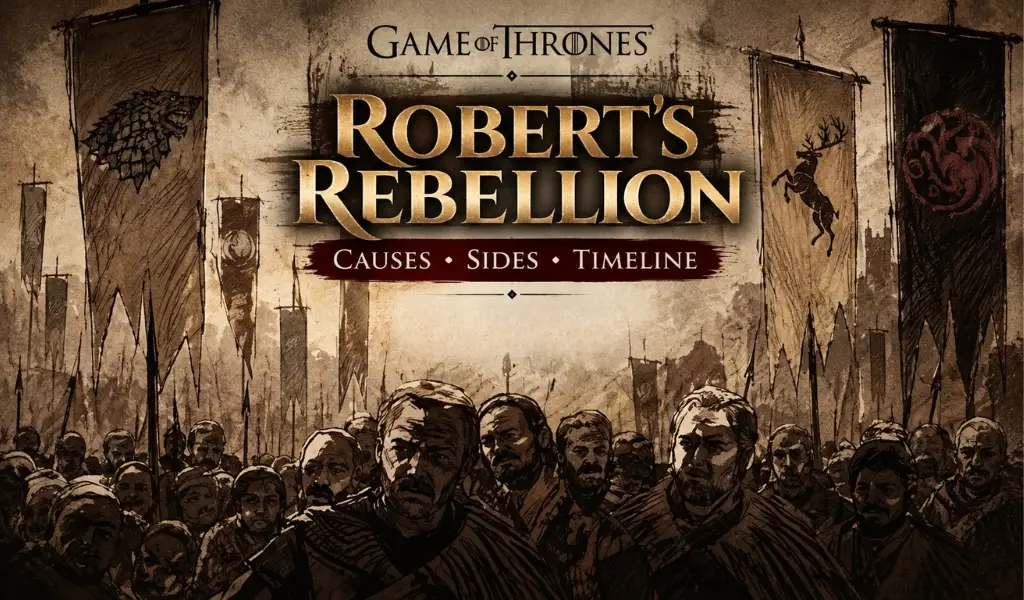
Few conflicts cast as long a shadow over Westeros as Robert’s Rebellion. It’s the war that put Robert Baratheon on the Iron Throne, exiled the last Targaryens across the Narrow Sea, and quietly planted the seed that would become Jon Snow. Yet for something so foundational to Game of Thrones, the show barely dramatizes it. Instead, viewers piece the story together through hushed conversations, old grudges, and one devastating flashback.
So what actually happened during Robert’s Rebellion? Who fought on which side, and why did the whole thing hinge on a decision Jaime Lannister made inside a burning throne room? This breakdown walks through the causes, the houses involved, the major battles, and the uncomfortable truth that Bran Stark eventually drags into the light.
How Long Before Game of Thrones Does Robert’s Rebellion Take Place?
According to George R.R. Martin’s source material, Robert’s Rebellion begins in 282 AC and lasts roughly a year. Game of Thrones picks up in 298 AC, which puts the war around 16 years before Ned Stark ever sets foot in King’s Landing as Hand of the King.
The math gets a little more interesting when you factor in Jon Snow. He’s born at the very tail end of the rebellion, and he’s 16 when season 1 begins. That puts the actual starting point of the conflict closer to 17 years before the show’s present timeline. It’s a gap large enough that an entire generation Jon, Daenerys, Robb, and the rest grows up only knowing the war through stories, not memory.
That distance is exactly why Game of Thrones treats Robert’s Rebellion the way it does. Rather than showing it in flashback after flashback, the show trickles out details as the plot demands them, letting the rebellion linger as unfinished business rather than settled history.
What Started Robert’s Rebellion?
There’s no single spark that ignites Robert’s Rebellion. It’s closer to a slow-burning fuse made up of one king’s cruelty, one couple’s forbidden romance, and one father’s grief. Each piece feeds into the next, and together they turn simmering resentment into open war.
King Aerys II “The Mad King” Targaryen’s Madness and Cruelty
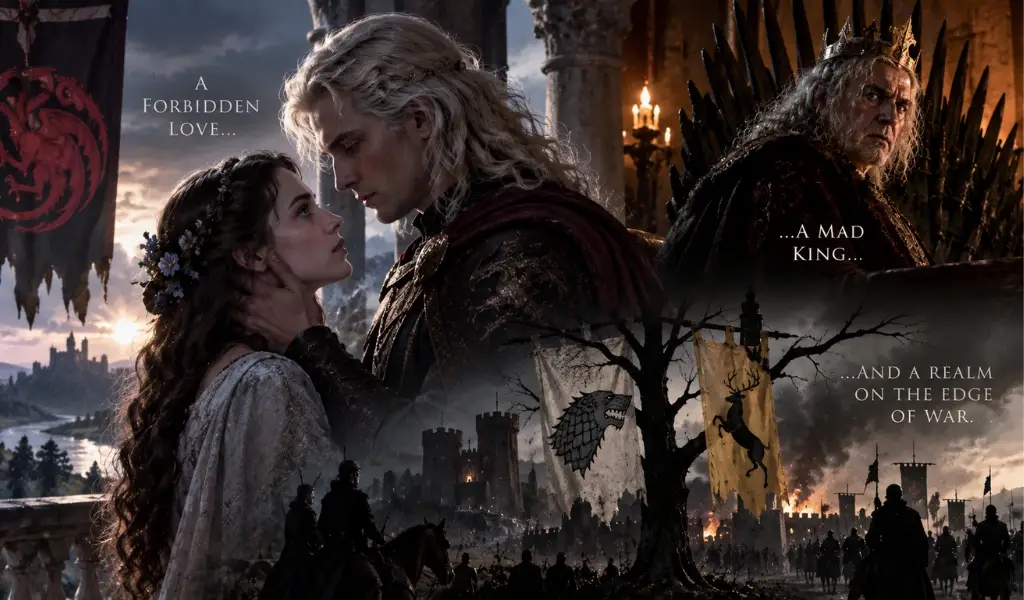
The rot starts at the top. King Aerys II grew increasingly unstable as his reign wore on, channeling irrational paranoia and unearned cruelty onto the people meant to serve him. His erratic behavior alienated even his most powerful allies Tywin Lannister, once his Hand of the King, eventually resigned the post after Aerys named Jaime to the Kingsguard, a move that stripped Tywin of his heir and his patience in one stroke.
Beneath the surface, older tensions were already simmering. The Great Houses of Westeros had never fully forgiven the Targaryens for conquering the continent through dragonfire, and as the Targaryen dragons died out over the generations, the family’s grip on that inherited authority grew shakier. Aerys’ cruelty simply gave the resentment somewhere to go. Even so, there was no real precedent for removing a sitting king by force, so despite the growing unease, no one moved against him. Not yet.
Lyanna Stark and Rhaegar Targaryen’s Elopement
The event that finally set the war in motion was deeply personal: the disappearance of Lyanna Stark, who was betrothed to Robert Baratheon at the time. As far as Robert and most of Westeros understood it, Prince Rhaegar Targaryen had abducted Lyanna and done unspeakable things to her.
The truth, as later revealed in Game of Thrones season 6, was nothing like the story Robert told himself. Lyanna went with Rhaegar willingly. He had his marriage to Elia Martell annulled before leaving King’s Landing, and the two were legitimately wed. Lyanna died shortly after giving birth to their son a boy the world would eventually come to know as Jon Snow. Robert’s jealousy and wounded pride never allowed him to consider that version of events. He went to war believing Lyanna had been stolen from him, and that belief alone was enough to move an army.
The Brutal Murders of Rickard and Brandon Stark
If Lyanna’s disappearance lit the fuse, the deaths of Rickard and Brandon Stark are what made the explosion unavoidable. Believing Robert’s account of the abduction, Brandon Stark rode to King’s Landing demanding Lyanna’s release. Aerys had him arrested for treason on the spot.
The Mad King then lured Rickard Stark to the capital under the pretense of negotiating his son’s freedom, only to take him prisoner as well. What followed was one of the cruelest scenes in the show’s backstory: Aerys had Rickard burned alive in the throne room while Brandon was forced to watch, a sword placed just out of his reach. The more Brandon strained toward it, the tighter a device around his neck choked him. Both father and son died in that room. When Aerys went further and demanded the heads of Ned Stark and Robert Baratheon, Jon Arryn made the call that turned grievance into rebellion: war, not surrender.
Robert’s Rebellion Sides and Houses (Stark, Baratheon, Targaryen)
Once the fighting started, Westeros split largely along existing alliances, though a few houses had very personal reasons for picking their side.
Houses on Robert’s Side (Stark, Baratheon, Tully, Arryn, Lannister)
Houses Stark and Baratheon formed the backbone of the rebellion from the outset Robert driven by a desire to end the Targaryen line entirely, Ned motivated by the murders of his father and brother. Their cause gained crucial reinforcement through marriage. Ned’s union with Catelyn Tully secured House Tully’s loyalty, while Jon Arryn’s marriage to Lysa Tully brought House Arryn into the fold as well. Since Jon Arryn had essentially served as a second father to Ned, that alliance came without hesitation.
House Lannister is the notable latecomer. Tywin Lannister held back until the outcome looked all but certain, then arrived at King’s Landing with 12,000 soldiers under the pretense of defending the city for Aerys. It was a betrayal disguised as loyalty, and it proved decisive.
Houses Loyal to the Targaryens (Tyrell, Tarly, Martell)
Not every great house turned against the crown. House Tyrell, led by Mace Tyrell, fought for Aerys throughout the conflict though some accounts suggest it was actually Randyll Tarly’s tactical mind, not Mace’s leadership, that delivered Robert’s only defeat at the Battle of Ashford.
House Martell’s loyalty ran even deeper, rooted in family ties: Princess Elia Martell was Rhaegar’s wife and was residing in the Red Keep for the duration of the war. Their support for the Targaryens ultimately did nothing to protect her. Elia and her children were murdered on Tywin Lannister’s orders during the Sack of King’s Landing, a betrayal that later fuels Oberyn Martell’s hatred of House Lannister in Game of Thrones proper.
Main Battles of Robert’s Rebellion Timeline
Robert’s Rebellion unfolded across roughly a year of fighting, marked by a handful of battles significant enough to shape the war’s outcome.
- Taking of Gulltown: The opening engagement, which kicked off fighting in the Vale of Arryn.
- Battles at Summerhall: A remarkable stretch in which Robert Baratheon won three separate conflicts in a single day.
- Battle of Ashford: Robert’s only defeat in the entire war, credited to Mace Tyrell publicly, though Randyll Tarly is often seen as the true tactician behind the win.
- Battle of the Bells: A pivotal clash that kept the rebellion alive during its most uncertain stretch.
- Battle of the Trident: The true turning point. Robert Baratheon killed Rhaegar Targaryen in single combat, breaking the back of the Targaryen war effort and convincing wavering houses like Lannister and Greyjoy that Robert’s side was now the winning one.
- Sack of King’s Landing: The final, brutal battle of the war, during which the capital fell and the Mad King met his end.
Each of these battles chipped away at Targaryen control, but it was the Trident that truly decided the war. Once Rhaegar fell, the outcome was less a question of if and more a question of how much longer Aerys could hold on.
How Robert’s Rebellion Ended and the Truth Behind It
Jaime Lannister Kills the Mad King
Robert never made it to King’s Landing for the war’s final battle. He was wounded at the Trident and unable to march on the capital, so Ned Stark led the remaining rebel forces to the Red Keep in his place. Tywin Lannister’s army arrived under the guise of defending the city, only to sack it once inside.
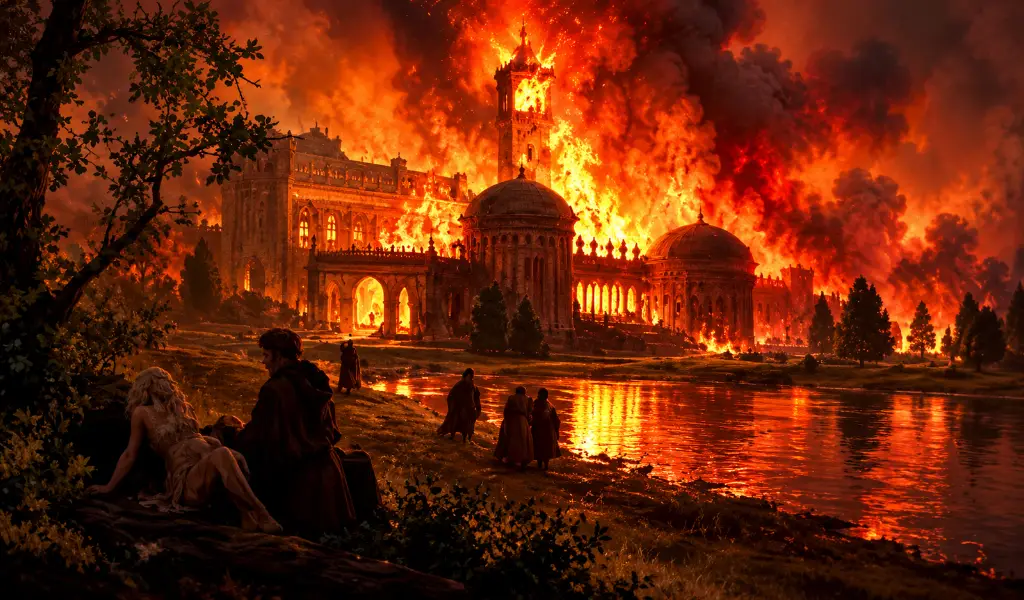
Cornered and facing certain defeat, Aerys ordered his men to torch King’s Landing with wildfire rather than surrender it. He also commanded Jaime Lannister, then a member of his own Kingsguard, to kill his father, Tywin. Instead, Jaime turned his sword on the king himself, killing Aerys II and earning the nickname “Kingslayer” in the process. He then handed the city over to Ned Stark. Robert arrived afterward to claim the Iron Throne, though a handful of smaller sieges still needed to be resolved before the rebellion was truly finished.
In the aftermath, Robert took the crown not Ned, despite Ned’s central role in the war largely because of his more prominent leadership during the fighting and a thread of Targaryen blood through his mother’s line. Jon Arryn became his Hand of the King, and Tywin Lannister offered his daughter Cersei’s hand in marriage to bind the Baratheon and Lannister houses together. Houses Tyrell and Martell, having backed the losing side, surrendered and pledged fealty to the new king.
The Rebellion Built on a Lie and Its Greater Fallout
The rebellion’s justification didn’t survive the story’s own ending. It isn’t until Game of Thrones season 6 that Bran Stark learns the full truth: Rhaegar never kidnapped or assaulted Lyanna. He loved her, married her, and stood beside her until her death shortly after childbirth. That child was Jon Snow, a secret Ned Stark carried to his grave. Realizing this, Bran states plainly that Robert’s Rebellion was “built on a lie.”
That doesn’t mean the war was pointless. Aerys II’s cruelty, his paranoia, and his willingness to burn his own capital to the ground made him unfit to rule regardless of what actually happened between Rhaegar and Lyanna. In that sense, removing him from power was arguably justified, even if the reason everyone believed at the time turned out to be false.
There’s a broader consequence to the rebellion that Game of Thrones never directly addresses, but House of the Dragon does: a prophecy called “The Song of Ice and Fire,” passed down through Targaryen kings, warned of a coming threat later revealed to be the Night King and the Army of the Dead. Because Robert violently inserted himself into the line of succession, that knowledge never passed to Westeros’s next ruler. Robert didn’t know about the prophecy, so he couldn’t warn his heir, Joffrey not that Joffrey would have believed him anyway. It’s a quiet, easily overlooked consequence of the rebellion, but it underscores just how much shifted when the Targaryen dynasty fell.
Robert’s Rebellion set every major storyline in Game of Thrones into motion, from the Stark-Lannister conflict to Daenerys’ journey across Essos. Understanding its causes and its cost makes the show’s present-day politics land with far more weight, especially once you realize how much of what everyone believed turned out to be wrong.
Frequently Asked Questions
Will there be a series on Robert’s Rebellion?
No, HBO has not announced or greenlit a television series about Robert’s Rebellion, but the era is being adapted into the Game of Thrones: The Mad King stage play.
What did Tywin do during Robert’s Rebellion?
Lord Tywin Lannister stayed neutral at Casterly Rock until the war’s final outcome was certain.
How many years passed between Robert’s Rebellion and Game of Thrones?
About 14 to 17 years passed between the end of Robert’s Rebellion and the start of Game of Thrones, depending on whether you follow the books or the TV show.
How many Targaryens were alive during Robert’s Rebellion?
There were roughly six to eight Targaryens alive during Robert’s Rebellion, depending on whether you count members in the Night Watch or secret births.
How old was Cersei during Robert’s Rebellion?
Cersei Lannister was about 16 to 19 years old during Robert’s Rebellion.