
Game of Thrones: The Blackfyre Rebellions, Explained
Long before Robert Baratheon ever sat the Iron Throne, Westeros had already torn itself apart over who deserved to sit there in the first place. The Blackfyre Rebellion wasn’t a single uprising but a string of five wars, stretched across six decades, all sparked by one dying king’s decision to legitimise his bastards. That single act of deathbed generosity from Aegon IV Targaryen would haunt the Seven Kingdoms for generations, plunging entire houses into civil war and giving rise to a rival dynasty that refused to die quietly.
Understanding the history of the Blackfyre Rebellions matters if you want to grasp why characters in Game of Thrones treat legitimacy and succession with such paranoid caution. Catelyn Stark’s warning to Robb about naming Jon Snow his heir isn’t just maternal anxiety it’s a direct nod to this bloody precedent. So, what was the first Blackfyre Rebellion, and how did it spiral into four more? Let’s walk through all the Blackfyre Rebellions in chronological order.
Where Did the Blackfyre Rebellion Begin?
The trouble started with Daemon Blackfyre, one of the bastard sons Aegon IV legitimised on his deathbed. Daemon wasn’t content with simply being acknowledged; he believed himself the rightful king. His argument rested on a sword: Blackfyre, the ancestral Valyrian steel blade of House Targaryen, had been gifted to him rather than to his trueborn half-brother, Daeron II. To Daemon and his supporters, that sword was as good as a coronation. To everyone else, it was theft dressed up as destiny.
Most of the great houses of Westeros stayed loyal to House Targaryen. But the resentment simmering beneath the surface among the so-called lesser houses found a natural outlet in Daemon’s cause, and House Blackfyre quickly gathered a formidable following.
What Was the First Blackfyre Rebellion?
Background and Daemon Blackfyre’s Claim
The First Blackfyre Rebellion, fought in 196 AC, was by far the largest and most devastating of the five conflicts. It pitted Daemon I Blackfyre against the reigning king, Daeron II Targaryen, and split the realm cleanly in two.
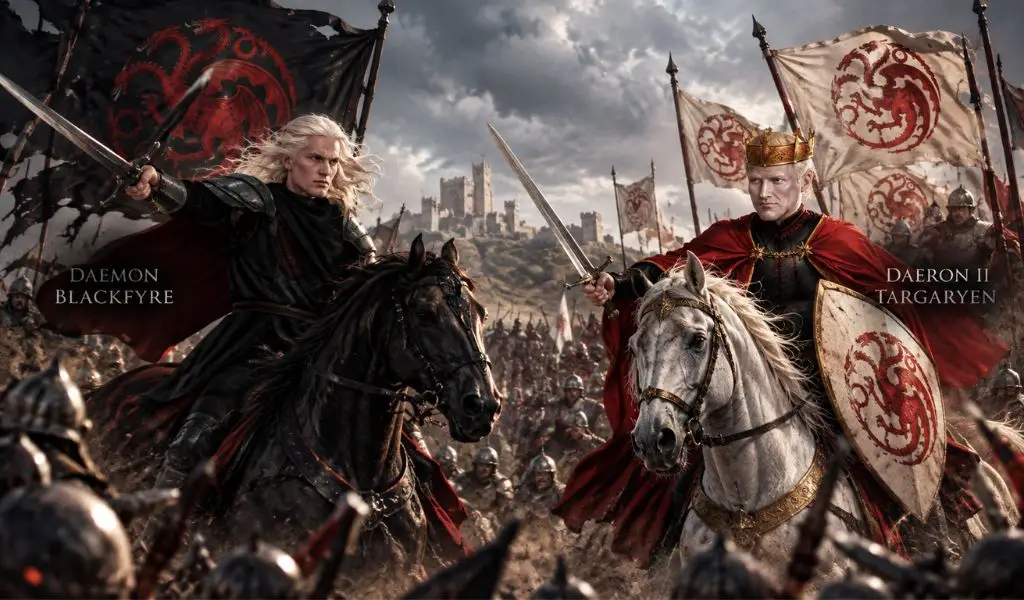
The spark came when word of Daemon’s claim reached Daeron’s court, reportedly delivered by Brynden “Bloodraven” Rivers, another of Aegon IV’s bastards and, notably, one who remained loyal to the crown. The king’s response was to send the Kingsguard to arrest Daemon before his rebellion could gather momentum. Daemon escaped, and his allies seized on the attempted arrest as justification for open war. Whether the arrest was truly baseless or simply came too late is one of those details history has conveniently blurred.
Battle of the Redgrass Field and Its Outcome
What followed was months of scattered fighting across the Vale, the westerlands, and the riverlands, described simply as clashes “between the black and red dragons.” Details are thin until the war reached its bloody conclusion at the Battle of the Redgrass Field, arguably the defining battle of the entire Blackfyre saga.
By the time the armies met, Daemon’s forces were within striking distance of King’s Landing. House Tyrell’s reinforcements hadn’t arrived, leaving the loyalist forces commanded by Maekar I Targaryen and the King’s Hand, Lord Hayford dangerously exposed until Gwayne Corbray of the Kingsguard arrived with support. Corbray and Daemon fought a duel lasting nearly an hour before Daemon was wounded. It was Bloodraven, however, who delivered the killing blow, picking off Daemon and his sons Aegon and Aemon from a vantage point above the battlefield with his archers, the Raven’s Teeth.
The rebels nearly broke and fled, but Aegor “Bittersteel” Rivers Daeron’s own half-brother, fighting for the other side rallied them back into the fight. Bittersteel took Bloodraven’s eye in the chaos before Baelor Targaryen’s spearmen crushed the rebel line against Maekar’s shield wall. The scale of the slaughter earned the Battle of the Redgrass Field its grim reputation: ten thousand men are said to have died “for Daemon Blackfyre’s vanity,” with countless more wounded. Bittersteel escaped across the narrow sea with the Blackfyre sword and Daemon’s surviving sons, ensuring the rebellion’s ideology, if not its army, lived to fight another day.
The Second Blackfyre Rebellion (212 AC)
If the first rebellion was defined by open warfare, the second was defined by its failure to ever really begin. Centred on Whitewalls in 212 AC, this uprising was less a rebellion and more a conspiracy that “ended with a whimper.”
The plot took shape around the wedding of Ambrose Butterwell to one of Lord Frey’s daughters. Many of Blackfyre’s old allies had lost lands, wealth, and titles after the first rebellion, and with Bloodraven now serving as Hand of the King to Aerys I Targaryen, resentment had only deepened. Conspirators Tommard Heddle and Gormon Peake convinced Butterwell to offer his dragon egg as a tournament prize, secretly rigging the contest to hand victory and the egg to Daemon II Blackfyre, who had infiltrated the wedding disguised as a hedge knight and musician calling himself John the Fiddler.
The scheme unravelled when Gormon falsely claimed the egg had been stolen, framing an innocent knight named Glendon Flowers. Duncan the Tall, known simply as Dunk, intervened, killed Tommard, and backed Glendon in a trial by combat against Daemon which Glendon won. Shortly after, Bloodraven arrived with overwhelming force: three Kingsguard, three hundred Raven’s Teeth, five hundred knights, and five thousand men-at-arms. Nobody answered Daemon’s call for support. He was imprisoned and eventually starved to death, Gormon was executed, and Whitewalls was razed. Butterwell survived, though stripped of everything he owned.
The Third Blackfyre Rebellion (219 AC)
Bittersteel wasn’t finished. In 219 AC, he crowned Daemon’s fourth son, Haegon, as King Haegon I Blackfyre and founded the Golden Company, a mercenary force that would become synonymous with the Blackfyre cause for the rest of its existence. This new invasion was met by Prince Maekar and his two sons, Aerion and Aegon, fighting on behalf of King Aerys I.
The rebellion once again came down to a personal duel Bittersteel against Bloodraven which Bittersteel lost. Haegon was killed by Bloodraven even after surrendering his sword, a detail that says plenty about how little mercy this conflict extended to the losing side. Strangely, King Aerys chose not to execute Bittersteel, sentencing him instead to the Night’s Watch. It proved a fatal miscalculation. As The World of Ice & Fire notes, Bittersteel still had powerful friends at court, who freed him before the year was out. He promptly returned to the Golden Company and crowned Haegon’s eldest son as King Daemon III Blackfyre in Tyrosh, setting the stage for round four.
The Fourth Blackfyre Rebellion (236 AC)
Battle of Wendwater Bridge
The fourth uprising had its roots in an earlier tragedy. Aenys Blackfyre, Daemon’s fifth son, attempted to press his own claim and was executed on Bloodraven’s orders following the Great Council of 233 AC. Three years later delayed by a brutal, prolonged winter Daemon III Blackfyre led the Golden Company across the narrow sea to avenge his brother, landing at Massey’s Hook in the crownlands.
By this point, support for the Blackfyre cause had thinned considerably. King Aegon V rode out personally to meet the invaders, joined by his three sons. The rebellion was crushed decisively at the Battle of Wendwater Bridge, where Daemon III was killed by none other than Dunk, the same knight who had once helped foil the second rebellion. Bittersteel retreated to Essos and died in exile some years later, reportedly “with a sword in his hand and defiance upon his lips.” It was a fitting, if futile, end for the man who had kept the Blackfyre flame burning across three failed uprisings. But even his death didn’t close the book entirely.
The Fifth Blackfyre Rebellion: War of the Ninepenny Kings (257 AC)
The final chapter belonged to Maelys Blackfyre, nicknamed “the Monstrous” for the remnant of a parasitic twin’s head protruding from his neck, a detail Westerosi chroniclers clearly couldn’t resist including. Maelys assembled a coalition of merchants, mercenaries, and pirates in Essos known as the Band of Nine, each member promised a kingdom carved from conquered territory. The scale of their ambition, and Dunk’s dry observation that “crowns were being sold nine a penny,” gave the War of the Ninepenny Kings its name.
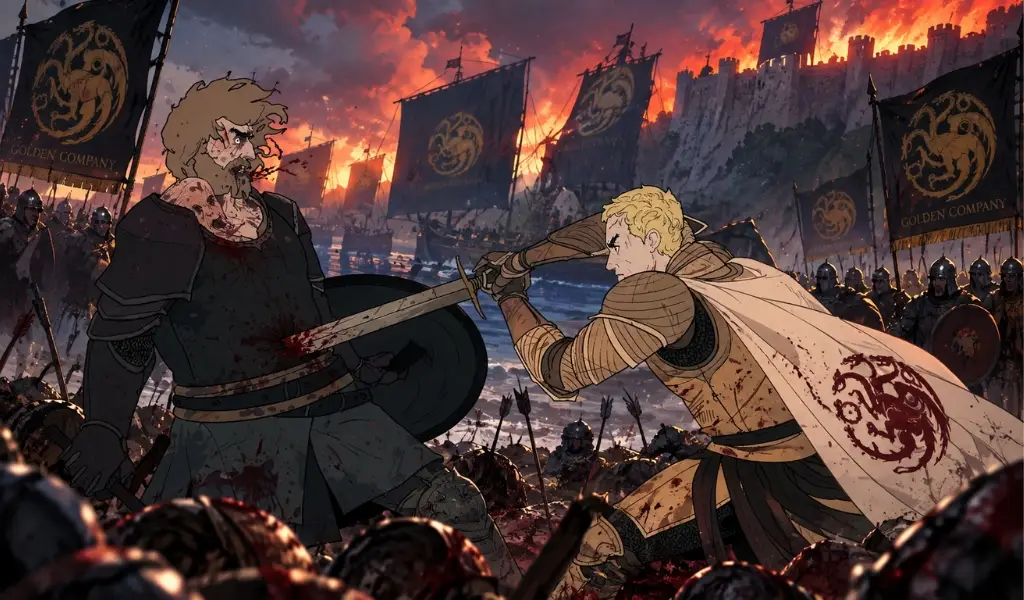
Initially, the Band of Nine racked up real victories, seizing the Disputed Lands, securing Tyrosh, and capturing the Stepstones. They were poised to strike at the Seven Kingdoms when King Aegon V’s forces arrived in overwhelming numbers: a hundred longships, a thousand knights, and ten thousand men-at-arms. Brynden Tully and a young Barristan Selmy distinguished themselves in the fighting, with Selmy personally killing Maelys and bringing the last of the Blackfyre line, and the last of the Blackfyre Rebellions, to a close.
Why the Blackfyre Rebellions Still Matter
Five rebellions, one sword, and sixty-one years of intermittent war all traceable back to a king who couldn’t resist legitimising his bastards on his deathbed. The Blackfyre Rebellions reveal just how fragile Targaryen authority always was beneath its dragon-scaled reputation, and how easily a contested claim can metastasise into generational conflict. It’s no accident that George R.R. Martin keeps circling back to this history through characters like Catelyn Stark, using it as a cautionary tale about the dangers of ambiguous succession.
If you’re working through Game of Thrones lore and want to understand why legitimacy is treated as such combustible material in Westeros, the Blackfyre Rebellions are essential reading. They’re proof that in this world, a single sword and a single grudge can outlast kings.
Frequently Asked Questions
How many Blackfyre Rebellions were there?
There were five Blackfyre Rebellions in the history of Westeros.
Did any of the Blackfyre Rebellions succeed?
No, none of the Blackfyre Rebellions succeeded.
What was the Blackfyre Rebellion about?
The Blackfyre Rebellion was a civil war in Westeros fought over who should sit on the Iron Throne between King Daeron II Targaryen and his half-brother, Daemon Blackfyre.
Do the Blackfyres still exist?
House Blackfyre is considered extinct in the male line after the death of Maelys the Monstrous during the War of the Ninepenny Kings.
Who killed the last Blackfyre?
Ser Barristan Selmy killed the last male-line Blackfyre pretender, Maelys the Monstrous, during single combat in the War of the Ninepenny Kings.
Did Duncan the Tall fight in the Blackfyre Rebellion?
Yes, Ser Duncan the Tall fought in the Fourth Blackfyre Rebellion in 236 AC, where he personally slew the Blackfyre pretender, Daemon III Blackfyre.
Who was king for each Blackfyre Rebellion?
King Daeron II Targaryen was the sitting monarch on the Iron Throne during the First Blackfyre Rebellion.