
Aegon’s Conquest Movie Epic Moments: 9 Scenes We Can’t Wait to See
When Game of Thrones: Aegon’s Conquest lands in cinemas in 2029, it won’t just be another instalment in the Thrones universe, it’ll be the origin story. Written by Andor scribe Beau Willimon and directed by A Knight of the Seven Kingdoms’ Owen Harris, the film promises to dramatise one of the most consequential campaigns in Westerosi history: the unification of seven warring kingdoms under a single Targaryen banner.
What makes this story such an obvious fit for the big screen isn’t just nostalgia for dragons and swordplay. It’s scale. Three dragons larger than anything seen since Old Valyria. A continent-spanning war fought across deserts, mountains, and stormy coastlines. And at the centre of it all, a trio of conquerors Aegon Targaryen and his sister-wives, Visenya and Rhaenys whose campaign reshaped the political map forever.
Drawing from George R.R. Martin’s Fire & Blood, here are nine moments from the Conquest that deserve the full cinematic treatment.
The Dawn of a New Age for Westeros
Before Aegon’s Conquest, Westeros was a patchwork of seven quarrelling kingdoms, each locked into its own cycle of petty wars and shifting alliances. There was no unifying throne, no single ruler commanding the continent’s loyalty. That changed when House Targaryen’s campaign swept through the realm, consolidating power under one crown for the first time in Westerosi history.
It’s a story that television could only hint at. The sheer scope of the Conquest, its battles, its political manoeuvring, its human cost demands the kind of visual spectacle that only a feature film can deliver. For longtime fans of Thrones and House of the Dragon, Aegon’s Conquest offers something rare: a chance to witness the foundational moments that every later betrayal, alliance, and war of succession was built upon.
1. Aegon’s Landing and the Birth of King’s Landing
Not every pivotal moment in the Conquest involves fire and carnage. Some matter simply because of what they set in motion. Aegon’s Landing is one of those moments a quiet beginning with enormous consequences.
When Aegon the Conqueror, Visenya, and Rhaenys first make landfall on the shores of the Blackwater Rush, they bring with them an army of only a few thousand men. It’s a modest force by the standards of the war to come, but it’s enough to begin a transformation that will echo through the centuries. The spot where they land will eventually become King’s Landing, named in honour of that first step onto Westerosi soil.
Few settings in the Thrones universe carry as much narrative weight as King’s Landing. Seeing it in its earliest form is nothing but three bare hills, untouched by the centuries of political intrigue that will later unfold there promises to be one of the film’s most striking visual contrasts.
2. The Destruction of Harrenhal by Balerion
After splitting from his sisters to begin the Conquest in earnest, Aegon sets his sights on the most dangerous opponent first: Harren the Black, King of the Isles and the Rivers. Harren’s reputation for cruelty is matched only by the castle he built to embody it Harrenhal, a fortress finished after forty years of construction and considered unbreakable.
Harren refuses to bend the knee. But his tyranny has earned him no allies among the Riverlands lords he’s subjugated, and when Aegon’s army arrives, they find the local houses ready to defect. Harren retreats behind Harrenhal’s walls, confident that no siege could break them.
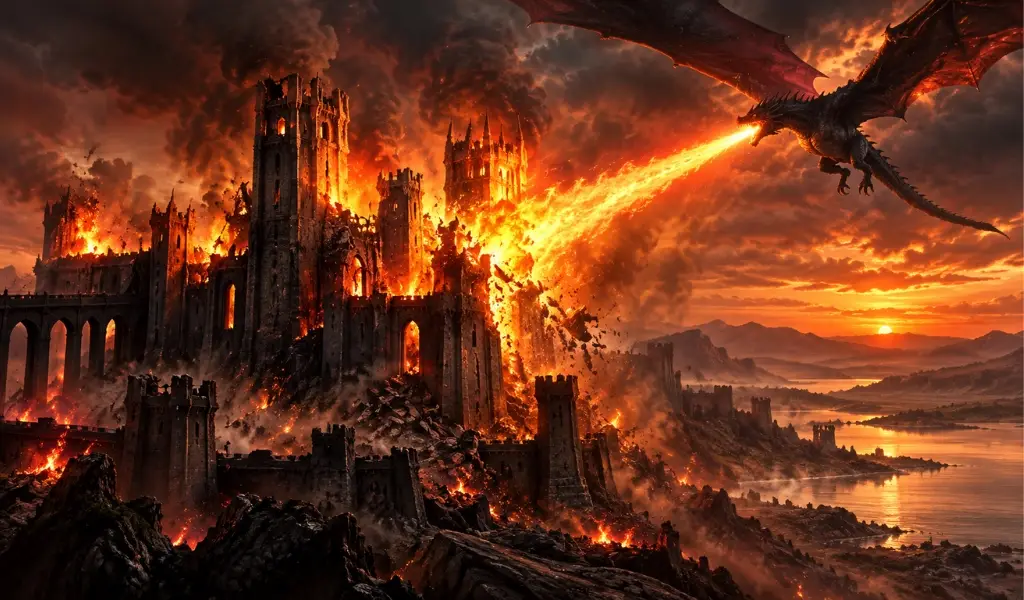
He doesn’t account for Balerion the Black Dread. Aegon flies his dragon over the castle under cover of night, descending within its walls and setting the entire structure ablaze. Stone twists and melts beneath Balerion’s black flames, a scene that should be extraordinary on film.
It marks the first great house to fall to Aegon’s campaign, with House Tully rising in Harren’s place as a key ally.
3. The Last Storm and Orys Baratheon’s Victory
While Aegon deals with Harrenhal, Rhaenys and Aegon’s bastard brother, Orys Baratheon, march on Storm’s End to face Argilac the Arrogant. Unlike Harren, Argilac refuses to hide behind castle walls. He leads his own army out into the Stormlands to meet the invaders head-on.
The resulting clash, fought in the midst of a violent storm, earns its name: the Last Storm. Rhaenys’s dragon, Meraxes, fights from the ground while Orys Baratheon ultimately defeats Argilac in single combat. It stands out as perhaps the most evenly matched land battle of the entire war, with real losses on both sides. When the fighting ends, the Baratheons claim Storm’s End as their seat one they’ll hold all the way through the events of Game of Thrones.
4. The Field of Fire: Dragons Unleashed
If Aegon’s Conquest has one battle it absolutely must get right on screen, it’s the Field of Fire. This is the only point in the entire campaign where all three Targaryen dragons Balerion, Meraxes, and Vhagar take to the field together, and the result is devastating.
Facing Aegon is a massive combined army from House Lannister of Casterly Rock and House Gardener, the ruling kings of the Reach. Their numbers vastly outstrip Aegon’s forces, and by conventional military logic, victory should have been theirs. But the dragons change everything. Aegon and his sisters set the battlefield alight while their own troops wait safely upwind, picking off any survivors who escape the flames.
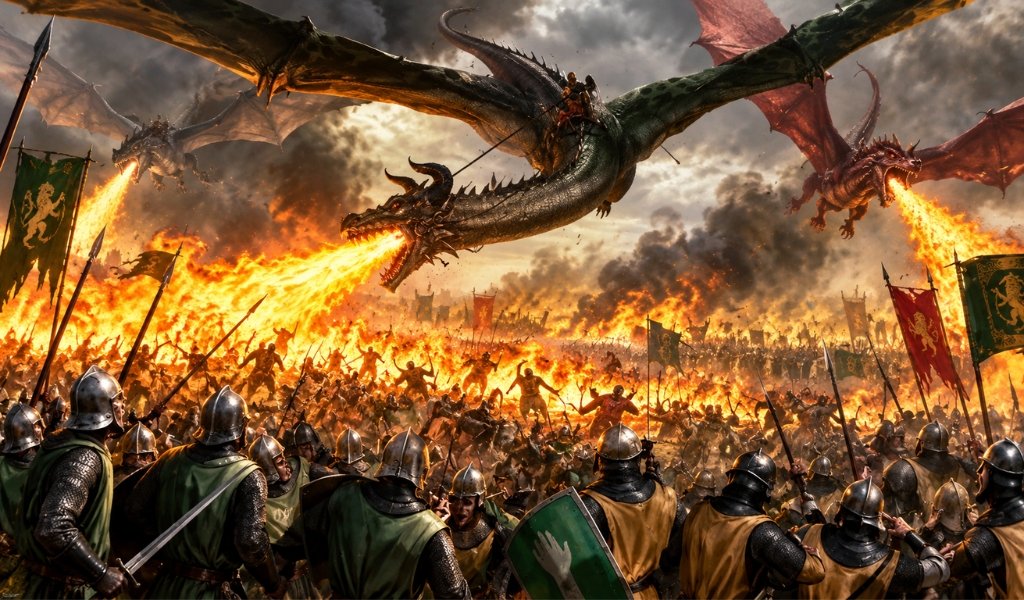
The aftermath reshapes the political map of the Reach entirely. House Gardener’s line is wiped out, the Tyrells rise to become Wardens of the South, and the Lannisters swear fealty to the Targaryens. Thousands die, tens of thousands more are wounded and almost none of the casualties belong to Aegon’s side. On an IMAX screen, this should be the film’s defining set piece.
5. The King Who Knelt: Torrhen Stark’s Surrender
The Field of Fire may mark the end of the Conquest’s bloodiest fighting, but the campaign isn’t finished. Only four of the Seven Kingdoms have submitted by this point, and word soon reaches Aegon that Torrhen Stark is marching south with a massive northern host to meet him.
Rather than clash in battle, the two leaders negotiate. Torrhen Stark ultimately bends the knee, earning the name history remembers him by: the King Who Knelt. He becomes the last King in the North until Robb Stark reclaims the title generations later in Game of Thrones.
This moment carries extra weight thanks to House of the Dragon’s revelation that Aegon’s entire campaign was driven by a prophetic dream foretelling a White Walker invasion centuries in the future. How the film chooses to address that prophecy during this confrontation with Torrhen Stark is one of the more intriguing questions hanging over the adaptation.
6. Visenya’s Bloodless Conquest of the Eyrie
Following Torrhen Stark’s surrender, the three Targaryens split up once more to deal with the last holdouts: the Eyrie, Dorne, and the Hightowers of Oldtown. Visenya Targaryen takes on the Eyrie, and her approach is as clever as it is bloodless.
The Eyrie is ruled in practice by Queen Sharra, acting as regent for her young son, King Ronnel Arryn. Sharra fortifies the Bloody Gate, expecting the Targaryens to attempt a conventional assault. Instead, Visenya simply flies Vhagar directly into the heart of the Eyrie. By the time Sharra races home, she finds Visenya already seated on the weirwood throne with young Ronnel on her knee.
The two women reach an accord, and the Eyrie bends the knee without a single battle. Visenya even takes Ronnel for a ride on Vhagar around the mountain, securing his loyalty in the process. As Martin writes in Fire & Blood, “it was said afterward that the little king flew thrice about the summit of the Giant’s Lance, and landed to find himself a little lord.” It’s one of the Conquest’s most elegant victories, and one that should translate beautifully to film.
7. The Yellow Toad of Dorne
While Visenya subdues the Eyrie, Rhaenys heads for Dorne and runs straight into the Conquest’s only real defeat. Meria Martell, remembered in Westerosi history as the Yellow Toad of Dorne, proves to be the one ruler who truly resists the Targaryens.
When Rhaenys arrives, she finds Dorne strangely empty of fighting men. Castle after castle offers nothing but women, children, and the elderly, all of whom claim the rest of Dorne’s men have simply gone “away.” The desert hides them too well for Rhaenys to track down, no matter how hard she searches.
Eventually, she meets the aging Meria Martell at Sunspear, where the Yellow Toad flatly refuses to bend the knee. Rhaenys warns that the Targaryens will return to finish what they started, but Meria is unmoved. It’s a rare moment of Targaryen failure, and it leaves Dorne outside Aegon’s rule even after his coronation technically making him King of six kingdoms, not seven. Whether the film ventures into the later Dornish wars, including the eventual deaths of Rhaenys and Meraxes, remains one of the biggest open questions about the adaptation.
8. The Coronations of Aegon I Targaryen
In Fire & Blood, the Conquest formally concludes with Aegon’s coronation at Oldtown, where the Hightowers and the Faith have already thrown their support behind him. Aegon parades through the city to cheering crowds before the High Septon anoints him ruler of the Seven Kingdoms.
But this isn’t actually his first coronation. That honour belongs to a smaller, earlier ceremony held right after Aegon’s Landing, when his banner is unveiled for the first time and Visenya places the Valyrian steel crown on his head. Given the symmetry between the two events, it wouldn’t be surprising to see the film use both coronations as bookends for the entire Conquest narrative.
9. The Forging of the Iron Throne
Throughout the Conquest, every sword surrendered by a defeated enemy is sent back to the growing settlement at King’s Landing. The reason becomes clear only at the campaign’s end, when Aegon returns to find those blades forged into something new: the Iron Throne.
Few symbols in Martin’s world carry as much narrative weight. The Iron Throne will go on to fuel generations of ambition, betrayal, and bloodshed essentially setting the entire Game of Thrones saga into motion. Watching Aegon Targaryen, First of His Name, take his seat on that throne for the first time should be the film’s quietest moment, but also one of its heaviest. Without this scene, none of the stories that followed over the past decade and a half of Thrones television would exist.
What This Means for Fans Heading Into 2029
Aegon’s Conquest isn’t just a prequel it’s the foundation stone for everything Game of Thrones has told us since. From the melting of Harrenhal to the forging of the Iron Throne itself, these nine moments carry the kind of scale and consequence that television alone could never fully capture. Whether Owen Harris and Beau Willimon can translate Fire & Blood‘s sprawling history into a single cohesive film remains to be seen, but the source material certainly isn’t short on spectacle.
Game of Thrones: Aegon’s Conquest premieres in theatres on 1 June 2029.