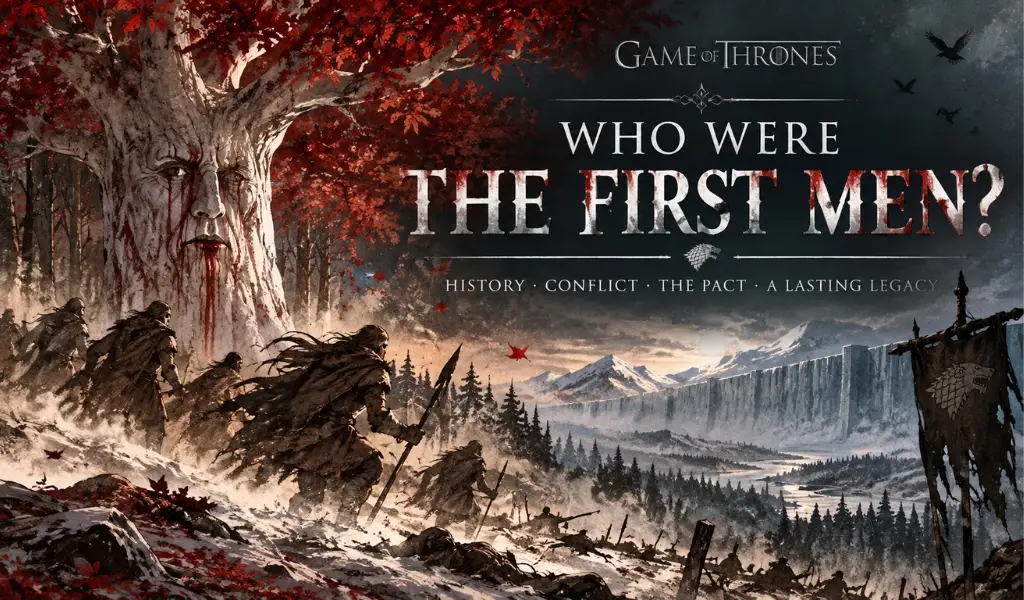

Game of Thrones: Who Were the First Men?
Long before Daenerys Targaryen’s dragons cast shadows over Westeros, and long before the Others began their grim march south, another race shaped the continent’s fate entirely. The history of First Men stretches back thousands of years, forming the bedrock upon which every subsequent Westerosi kingdom, custom, and conflict was built. Their story is one of invasion, war, uneasy peace, and an enduring legacy that still pulses through the North long after their reign ended.
To understand Westeros as we see it in Game of Thrones, you have to go back to a time before the Seven Kingdoms existed, before the Andals crossed the Narrow Sea, and before the Wall rose to guard against ancient horrors. This is where the tale of the First Men begins, and it’s a tale worth unpacking in full.
History of First Men: Introduction to the First Men in Westeros
Westeros wasn’t always the domain of men. For thousands of years, the continent belonged to the Children of the Forest and the giants, ancient beings with a deep, almost mystical bond to the land itself. That arrangement changed irrevocably when a new force arrived from across the sea, forever altering the balance of power. Understanding who were the First Men in Game of Thrones means understanding a foundational clash of civilisations, one that echoes through every major House and custom still standing by the time Ned Stark loses his head in King’s Landing.
The First Men didn’t simply settle Westeros. They conquered it, clashed with its original inhabitants, and eventually forged a fragile alliance that would define an entire age. Their story isn’t just backstory filler for Martin’s world; it’s the skeleton key to understanding Northern identity, the Wall’s origins, and the deep-rooted tensions that still simmer between the Starks and the Free Folk.
Who Were the First Men?
Crossing the Arm of Dorne
According to Westerosi legend, the First Men arrived on the continent somewhere between eight and twelve thousand years before Aegon Targaryen’s Conquest.
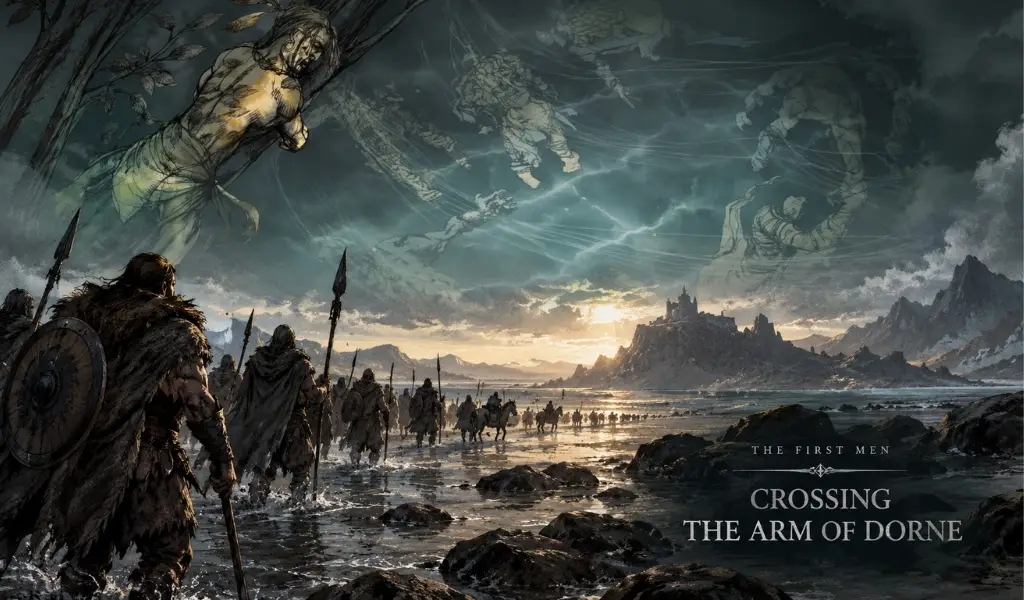
They crossed via a land bridge known as the Arm of Dorne, a route that has long since vanished beneath the sea. No surviving account explains why they made the journey. What the lore does confirm is that they came under the banner of a figure known only as “the First King,” a title that shifts names depending on which Westerosi culture is telling the story.
Once they’d established a foothold in Dorne, the First Men didn’t stay put. They spread outward, claiming territory across the entirety of the continent. This expansion inevitably brought them into direct conflict with the beings who already called Westeros home: the Children of the Forest.
Conflict with the Children of the Forest
The name “Children of the Forest” wasn’t chosen by the Children themselves. It was the First Men who coined it, a reference to their diminutive size and childlike features. The Children actually referred to themselves as “those who sing the song of the earth,” a name that reflects their profound, almost supernatural connection to Westeros itself.
That connection is central to understanding the conflict that followed. The story of the Children of the Forest and the First Men is fundamentally one of cultural collision. The First Men arrived with little regard for the land’s sacred balance. They built holdfasts, cleared farmland, and chopped down weirwood trees for timber, trees the Children had used for centuries to commune with their gods. To the Children, this wasn’t just inconvenient. It was sacrilege, and it posed a genuine threat to the natural order they’d maintained for millennia.
Despite possessing magic and an intimate knowledge of Westerosi terrain, the Children were ultimately outmatched. The First Men had arrived from Essos in the midst of a Bronze Age, equipped with swords, shields, and war horses. They were bigger, stronger, more numerous, and better armed, and the war for Westeros didn’t last long as a result.
There’s a striking piece of legend tied to the war’s final days: desperate and facing extinction, the Children allegedly turned to dark magic to sever the Arm of Dorne entirely, hoping to cut off the flow of invaders. This cataclysmic act supposedly created the Stepstones and transformed the Neck into the boggy swampland it remains in the present timeline. It was a drastic gamble, but it didn’t change the war’s outcome.
The Pact and the Age of Heroes
With neither side able to claim total victory, the First Men and the Children eventually negotiated a peace agreement known as the Pact. Under its terms, the Children retained dominion over the deep forests, while the First Men held the rest of Westeros. In return, the First Men agreed to stop felling weirwood trees, a compromise that ended the fighting and opened the door to something unexpected: genuine friendship.
The Pact Westeros history describes four thousand years of peace, a period known as the Age of Heroes. The bond between the two peoples ran deep enough that the First Men abandoned their original religious beliefs entirely and adopted the Children’s faith instead. They began carving faces into weirwood trees just as the Children did, transforming them into the heart trees still found across the North today. The Children also taught the First Men to use ravens as long-distance messengers, and legend holds that these early ravens could actually speak the messages they carried, rather than simply transporting scrolls.
The First Men and The Long Night
Perhaps the clearest evidence of how deep this alliance ran came during the Long Night, when the Others swept down from the Lands of Always Winter and threatened to annihilate everything living. Facing a shared existential threat, the Children, the First Men, and the giants set aside any remaining differences and fought together.
Their combined effort succeeded. The Others were driven back beyond the northernmost reaches of Westeros, and in the aftermath, the three peoples built the Wall, an enormous barrier intended to guard against any future return of the ice wraiths. The First Men and the Long Night are inseparable in Westerosi lore, representing the high point of cooperation between men and the Children, born out of necessity but no less significant for it.
Who Is Descended From the First Men?
The First Men’s dominance didn’t last forever. Sometime after the Long Night, a new group, the Andals, arrived from across the Narrow Sea armed with superior iron weaponry. Over hundreds of years of warfare, the Andals conquered or married into most of the southern kingdoms, bringing their worship of the Seven with them. This invasion effectively wiped out what remained of the Children of the Forest and reshaped Westeros’s political and cultural landscape almost entirely.
The North, however, told a different story. It largely remained under the control of the First Men and their descendants, which is precisely why Northern culture looks so different from the rest of Westeros by the time Game of Thrones begins.
Northern Houses and House Stark Traditions
The descendants of the First Men and Northern Houses share a lineage that stretches back thousands of years, and no family embodies that heritage more clearly than House Stark. The Stark name reportedly dates back to at least the Long Night itself, making it one of the oldest continuously recognised Houses in Westeros.
Many First Men traditions survive in House Stark’s customs to this day. The family worships the Old Gods, with a heart tree still standing in the godswood at Winterfell. They also uphold guest right, an ancient custom stating that once a host offers a guest food and shelter, that guest is protected from harm under the host’s roof. Another surviving tradition holds that whoever passes a death sentence must personally carry out the execution. This wasn’t just ceremonial; it was designed to stop rulers from treating human life carelessly, forcing them to confront the weight of their own judgments directly.
The Free Folk or Wildlings
The Free Folk, commonly called wildlings, share the exact same ancestry. They descend from First Men who happened to be living north of where the Wall was eventually built, leaving them stranded on the wrong side of the barrier once it went up. Thousands of years of separation have produced distinct customs, but many core beliefs remain strikingly similar to those held by the Starks and other Northern Houses.
That shared bloodline hasn’t fostered goodwill, though. If anything, it deepened resentment. Many among the Free Folk view the Northern Houses as complicit in the ongoing suppression of their own distant kin, and the Starks have arguably reinforced that divide by positioning themselves as more civilised. In reality, the difference between the two groups has never been about superiority. It comes down to nothing more than geographical chance and which side of the Wall their ancestors happened to be standing on.
The Lasting Legacy of the First Men
The fingerprints of the First Men are everywhere in Westeros, even thousands of years after their reign ended. The Wall still stands. Weirwood trees still mark godswoods across the North. The tension between Northerners and the Free Folk still simmers, rooted in a divide that’s more accident of geography than genuine difference. Even the guest right, so catastrophically violated at the Red Wedding, traces its origins straight back to customs established during the Age of Heroes.
Though the First Men were eventually absorbed into what became the Seven Kingdoms, and most physical traces of their civilisation have long crumbled, their influence never really disappeared. It lives on in Northern halls, in old customs, and in the blood of nearly every character wearing a direwolf sigil. For anyone trying to make sense of Westeros’s deeper history, the First Men aren’t a footnote. They’re the foundation everything else was built upon.