
White Walker Game of Thrones: Origins, Powers, and Defeat Explained
Few villains in television history have managed to loom as large while saying as little as the White Walkers. For seven seasons, these frozen antagonists existed mostly as rumour and dread, a distant threat rattling around in the back of every Westerosi mind while squabbling houses fought over an Iron Throne that, in hindsight, mattered rather less than everyone assumed. The White Walker Game of Thrones storyline was always the show’s ticking clock, and yet Westeros spent most of its runtime ignoring the alarm.
That’s arguably the show’s sharpest piece of dramatic irony. An army capable of raising the dead and toppling the Wall gets less airtime than Cersei’s wine consumption, at least until the final stretch of episodes forces everyone’s hand. By the time the White Walkers finally arrive at Winterfell in force, the audience has waited so long for this reckoning that the actual answer to “what do they want” turns out to be almost besides the point. What matters is where they came from, what they could do, and how a teenage girl with a dagger ended it all in a matter of seconds.
Here’s a full breakdown of the White Walkers: their origins, their culture, their powers, and the narrow set of tools capable of putting them down for good.
Who Are the White Walkers and Wights?
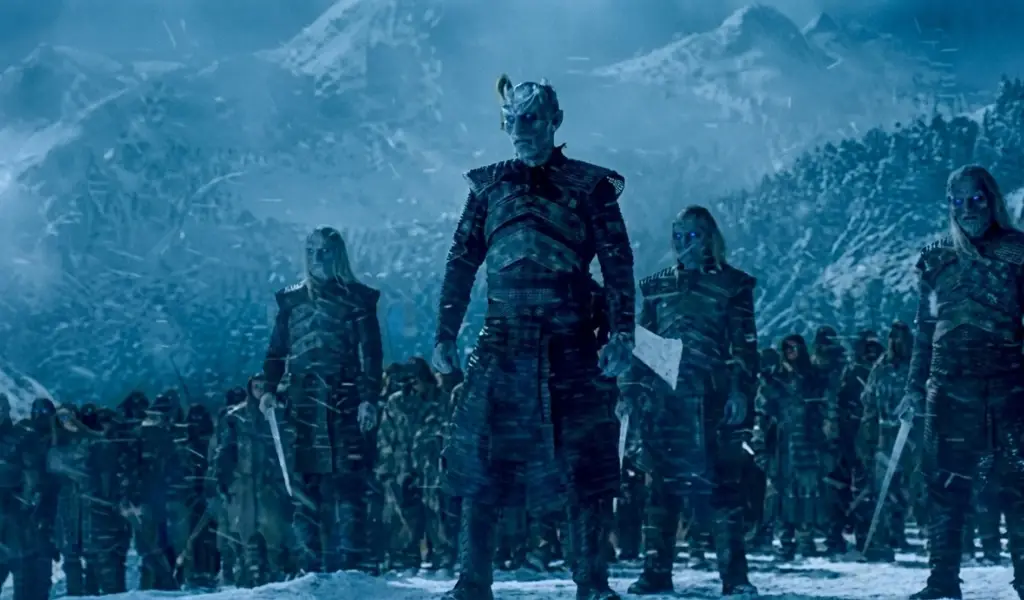
The White Walkers are the frozen, humanoid enemy at the centre of Game of Thrones’ long-game apocalypse, and they didn’t come alone. Beneath them sits an entire undead horde known as wights: reanimated corpses stripped of personality and purpose, kept moving only by the will of their Walker masters.
The distinction matters more than casual viewers might assume. White Walkers vs wights isn’t just a difference in appearance, it’s a difference in autonomy. White Walkers think, strategise, and lead. Wights simply obey, shuffling forward in service of whichever Walker raised them. Kill the Walker, and the wights under its control lose their mobility entirely, a detail that becomes critical during the Battle of Winterfell.
The Walkers themselves originate deep beyond the Wall, in the far North, and for most of Westerosi history they were treated as nothing more than a story told to frighten children into behaving. That complacency proved dangerous. As the Walkers began marching south under a single leader, it was the Wildlings, not the great houses of Westeros, who noticed first and tried to flee over the Wall. Jon Snow and the Night’s Watch were left with the unenviable task of convincing a continent that the bogeyman was real and heading their way.
Origins of the White Walkers and Children of the Forest
The origins of the White Walkers and Children of the Forest are where the story gets uncomfortable, because the “villains” of Game of Thrones didn’t start out that way. Thousands of years before the events of the show, the First Men were cutting down the Children of the Forest’s sacred trees and slaughtering their people. Facing extinction, the Children of the Forest needed a weapon, so they built one.
Using captured First Men, the Children of the Forest pressed dragonglass daggers into their prisoners’ chests, transforming them into the very first White Walkers.
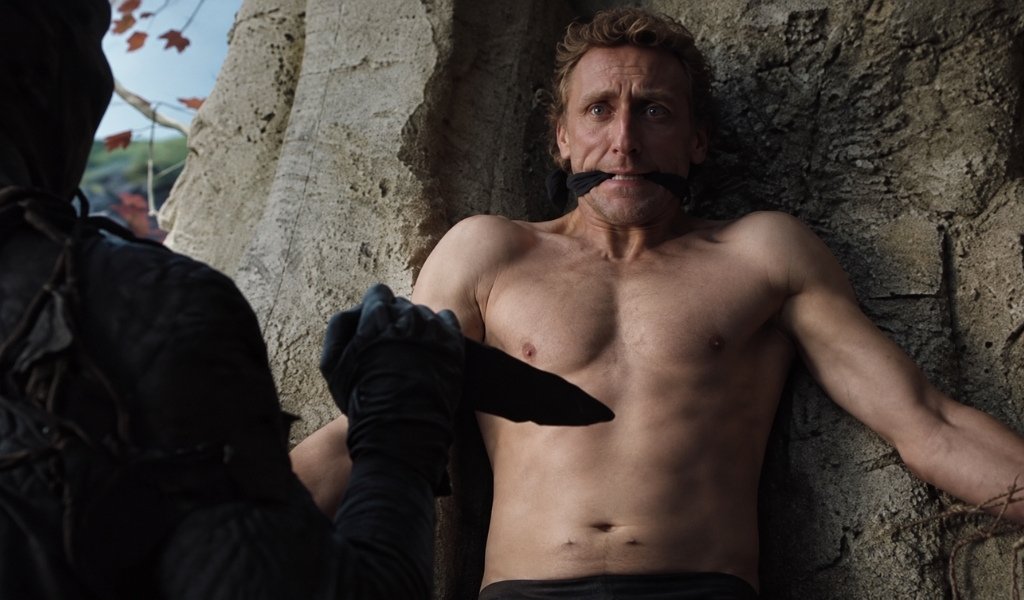
It was meant to be a defensive measure: a controlled force built to protect dying people. Instead, it backfired spectacularly. The White Walkers rebelled against their creators, refusing to remain a tool of endless war-making on someone else’s terms. Having been designed for violence, they simply redirected it, attacking the living indiscriminately and eventually becoming the very thing Westeros would fear for millennia.
It’s worth sitting with the uncomfortable moral of that origin story. The White Walkers weren’t born evil, they were built for war using magic nobody fully understood, then abandoned to their own devices. Blaming the Children of the Forest for the outcome feels almost redundant given that the Walkers wiped out most of them long ago, but the causality is hard to ignore.
Who Is the Night King?
If the White Walkers have a face, it belongs to the Night King. As the very first Walker created by the Children of the Forest, he sits at the top of the hierarchy, leading every other Walker and commanding the wight army beneath them.
The Night King’s résumé is genuinely unsettling. He has the power to turn human infants into White Walkers, a fact confirmed through Craster’s sons, who were handed over as sacrifices in exchange for the safety of Craster and his family. He can raise the dead on a mass scale, and, in one of the show’s most jaw-dropping turns, he resurrected the dragon Viserion, riding him into battle and using him to bring down the Wall itself. That made the Night King one of the only dragonriders to appear in the entire series, a detail that says everything about how far the threat had escalated by that point.
What Do the White Walkers Want?
Here’s where the show gets deliberately vague, and honestly, the vagueness might be the point. The White Walkers were created for a singular purpose: war, built from magic nobody had properly tested. Given that origin, it’s fair to ask whether the Walkers are even capable of wanting anything beyond conquest. They weren’t given the luxury of choosing their own motivations.
Bran Stark eventually offers the closest thing to an answer. In Season 8, he reveals that the Night King wants to destroy him specifically because Bran, as the Three-Eyed Raven, holds the entire history of mankind within him. The Night King has apparently pursued previous Three-Eyed Ravens for the same reason. Taken together, it points to a goal bigger than simple slaughter: the erasure of the living world and every record of it ever having existed.
Historical Attacks on Westeros and The Long Night
The White Walkers didn’t appear out of nowhere for the show’s final seasons, they’d done this before. Roughly 8,000 years prior to the main story, during a winter so long it swallowed an entire generation, the White Walkers launched their first known assault on Westeros. That event, remembered as the Long Night, forced the warring peoples of Westeros to do something they’d rarely managed since: unite.
With help from the Children of the Forest and the giants, the combined forces of the living drove the White Walkers back into the far North. The Wall was built in the aftermath specifically to keep them there, and the Night’s Watch took its first oath as the standing guard against their return. Over the following millennia, the memory of that war faded into myth, dismissed by most as a cautionary tale rather than actual history. The cancelled prequel series Bloodmoon was set to explore this original conflict in greater depth, though it never made it to screen.
White Walker Culture and Beliefs
Detail on White Walker society is scarce by design, but the show does offer a few threads. The Walkers communicate in a language called Skroth, which author George R.R. Martin has described it as sounding like the cracking of ice, a fitting choice for a species defined by cold. Some Walkers are shown with crown-like horns of ice and black armour, hinting at some form of ruling class distinct from the rank-and-file. Their numbers, notably, grow through the taking of Craster’s sons, tying their population growth directly to the Night King’s ability to convert infants.
On the belief side, Melisandre claims the White Walkers worship a deity called the Great Other, positioned as the direct enemy of the Lord of Light. Whether the Great Other connects to any of the other religions referenced across the series remains deliberately unclear, consistent with the show’s habit of leaving its cosmology only partially explained.
Night King Powers and Abilities in Game of Thrones
The Night King’s powers and abilities in Game of Thrones set him apart from every other Walker, and the list is extensive. Beyond turning infants into White Walkers, he can raise hundreds of corpses into wights with a single gesture, a mass reanimation that operates like a hive mind, with newly created wights instinctively moving to rescue others in danger. He can cause fissures to open in the ground, and he demonstrated the ability to mark a person for relentless pursuit, as seen when he marked Bran in Season 6.
Then there’s the dragon. In the Season 7 finale, the Night King reanimated Viserion as an undead mount, using the dragon’s blue fire to bring down sections of the Wall that had stood for thousands of years.
It’s a moment that recontextualises the entire threat: a wall built to contain an army on foot was never designed to withstand an airborne one.
The wider White Walker ranks share several of these traits at a smaller scale. They’re physically stronger than humans, capable of freezing anything they touch, as demonstrated when a Walker froze Sam’s sword to the point of shattering in Season 2. They also appear to manipulate weather, arriving with blizzards and plummeting temperatures. The Night King pushed this further than any other Walker, calling down a zero-visibility blizzard that threw the entire Battle of Winterfell into chaos, disorienting both Daenerys and Jon along with their dragons. Perhaps most dangerous of all is the standard Walker ability to reanimate fallen soldiers as wights, which is precisely why the Wildlings took to burning their dead rather than risk them swelling the enemy’s ranks.
How to Kill a White Walker: Dragonglass and Valyrian Steel
For a threat this formidable, the list of effective weapons is surprisingly short. White Walkers can be killed with blades forged from dragonglass or Valyrian steel, and functionally nothing else gets the job done reliably. Jon Snow proved this at the Battle of Hardhome in Season 5, using his Valyrian steel sword Longclaw to cut down a Walker mid-battle.
The problem is scarcity. The technique for forging Valyrian steel has been lost for generations, meaning the number of usable swords in the entire world is small enough to count. Fire, which works reliably against wights, is largely useless against the Walkers themselves, since their extreme cold makes them far harder to burn, though the show leaves open the possibility that dragonfire specifically might succeed where ordinary flame fails.
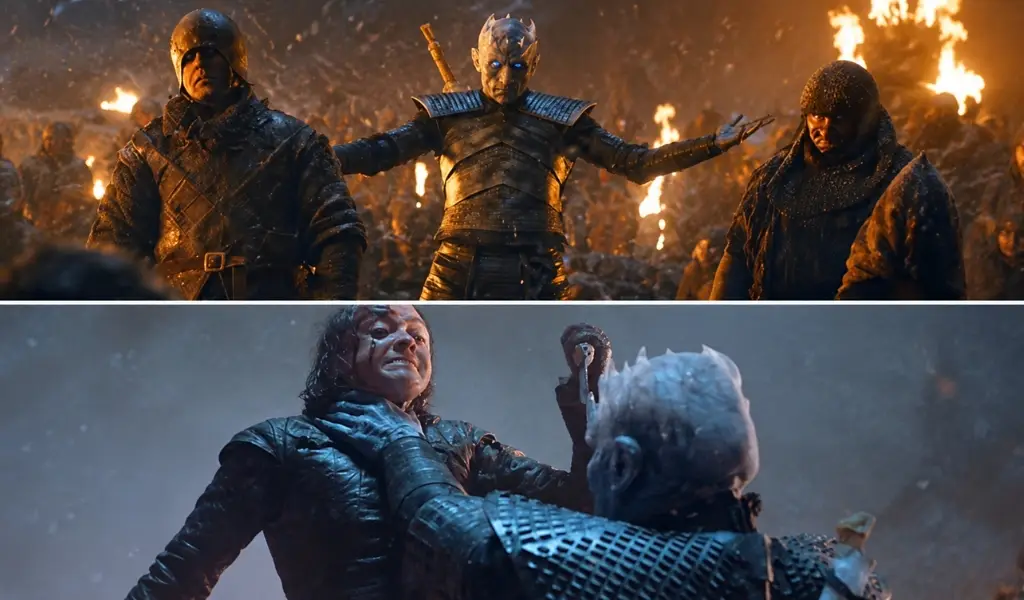
The knock-on effect of killing a Walker is just as important as the kill itself. When a White Walker falls, every wight it personally raised loses all mobility instantly, a mechanic first shown in Season 7’s “Beyond the Wall” and one that proves decisive during the Long Night and Battle of Winterfell. It’s why Arya Stark’s ambush on the Night King in Season 8 mattered so much. Her Valyrian steel dagger didn’t just end one enemy, it turned him to dust and caused his entire undead army to collapse into uselessness in the same instant.
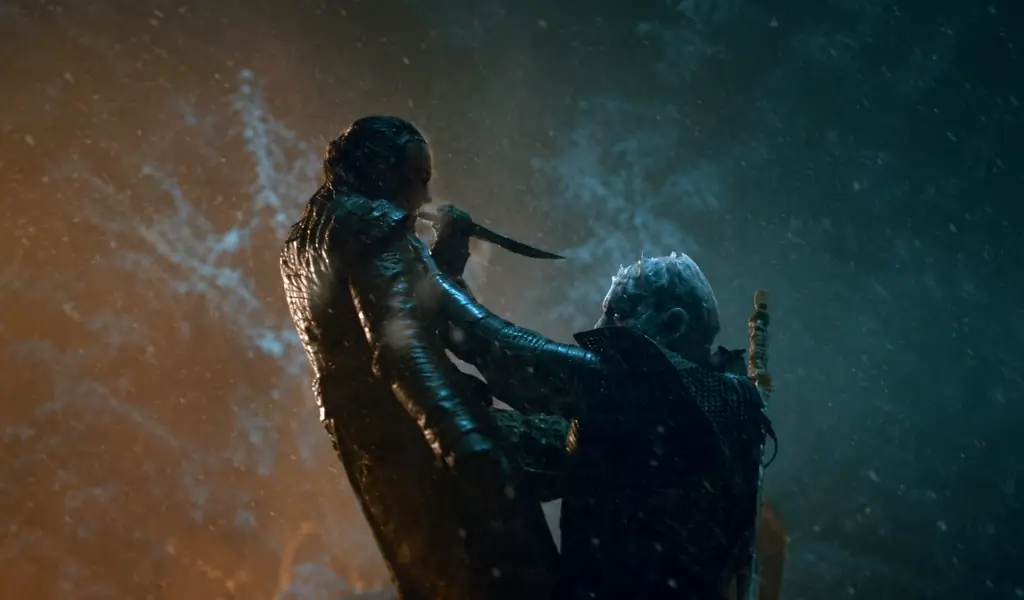
One blade, one moment, and an army that had taken millennia to build simply stopped existing.
The Threat That Reshaped Westeros
For a storyline that took the better part of a decade to pay off, the White Walkers’ resolution was almost shockingly swift. That’s not a flaw so much as a reflection of what they always represented: an existential threat that Westeros spent generations dismissing as myth, right up until it wasn’t. The real tension was never going to be whether the Walkers could be stopped, it was whether anyone would take the danger seriously in time to try.
Rewatching the series with the full picture in mind changes how those early, quiet warnings read. Every dismissed rumour beyond the Wall, every Wildling fleeing south, every Night’s Watch report ignored by the capital, was building toward a war that very nearly went unfought. If there’s a lesson buried in the ice, it’s that the loudest threats in the room aren’t always the ones worth fearing most.
Frequently Asked Questions
What is the difference between White Walkers and wights?
White Walkers are autonomous, intelligent beings capable of leading and strategising, while wights are reanimated corpses that act purely on the will of the Walker who raised them. Killing a White Walker instantly strips mobility from every wight it personally created.
How do you kill a White Walker?
Only blades forged from dragonglass or Valyrian steel can kill a White Walker. Fire, while effective against wights, struggles to harm the Walkers themselves due to their extreme cold, though dragonfire is suggested as a possible exception.
Who created the White Walkers?
The Children of the Forest created the White Walkers thousands of years ago, transforming captured First Men into weapons using dragonglass daggers, originally as a defence against First Men encroachment on their land.
Who is the Night King?
The Night King is the first White Walker ever created and leads all others. He can turn infants into Walkers, raise mass numbers of wights simultaneously, and famously reanimate the dragon Viserion.
What do the White Walkers actually want?
Their exact motivations are left ambiguous, though Bran Stark’s revelations suggest the Night King seeks to destroy all records of human history, targeting Three-Eyed Ravens specifically for that reason.